As a HealthBRIDGE student you will undertake two phases of training: a 1-year foundation programme, followed by a 3-year PhD project. Throughout, you will develop specialist scientific knowledge, strengthen translational insight and develop professional skills that support research impact across clinical, commercial and policy settings.
All students who start HealthBRIDGE at the same time will take programme-specific training together – allowing you to build a peer network for learning and support.
Core themes across the programme
- Partnership with a health charity related to your PhD project;
- Opprtunities for a work placement with a collaborative partner;
- Professional and transferable skills development;
- Data and digital literacy;
- Commercialisation and policy pathways to impact;
- Leadership development;
- Research culture, unconcious bias and active bystander training.
The HealthBRIDGE Training Journey
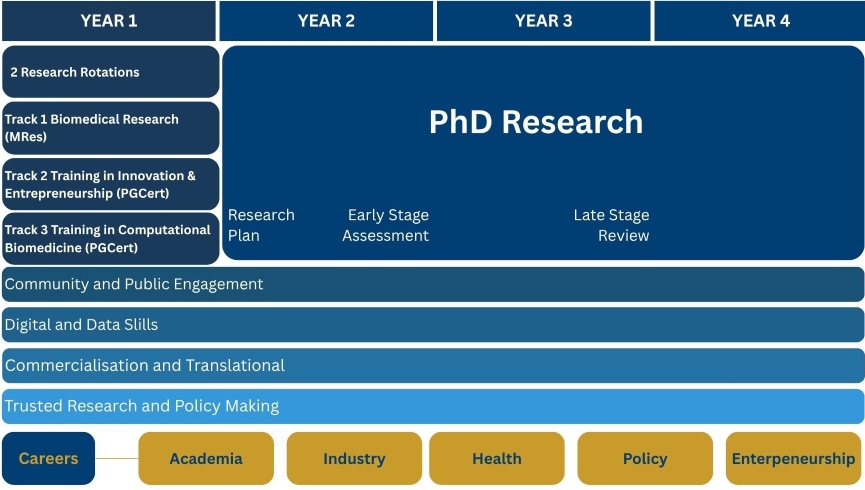
Foundation Year: Exploration and Breadth
During year 1, you will explore potential research directions through two structured research rotations and work with prospective supervisors to develop your PhD project. You will also undertake HealthBRIDGE training activities during the foundation year.
Foundation Year: Exploration and Breadth
Track 1: MRes Biomedical Research
This well-established MRes programme will provide you with broad, foundational training in research activities such as poster presentations and grant writing.
The programme of lectures, seminars and workshops you take will depend on the MRes stream you choose.
Your lab rotations will form part of your MRes curriculum. Upon successful completion of the year, you will be award the MRes degree.
Track 2: Training in innovation and entrepreneurship
You will take the following modules which are delivered by the Bioscience Futures team: Innovations in Bioscience, Communication for Impact, and Ideation and Entrepreneurship.
Upon successful completion of this training, you will be awarded a PGCert.
Alongside this training, you will undertake two research rotations.
Track 3: Training in computational biomedicine
You will take the following modules which are delivered by the Computational Biomedicine teaching team: Data Science Foundations for Biomedical Computational Biology, and Introduction to Biomedical Machine Learning and Biostatistics.
Upon successful completion of this training, you will be awarded a PGCert.
Alongside this training, you will undertake two research rotations.
Preparing for the PhD Phase
Towards the end of the Foundation Year, students submit a PhD project proposal developed with prospective supervisors. Projects should align with one or more of themes listed in the MRC's research remit, with interdisciplinary approaches encouraged, particularly in disease diagnosis, treatment and prevention.
PhD Phase: Commitment and Depth
During your three-year PhD project, you will benefit from a variety of training opportunities across your faculty, the Early Career Researcher Institute, as well as HeathBRIDGE. You will also have access to the MRC Supplement Scheme providing support for high-cost or exceptional training, placements and internships as well as other opportinites.
PhD Phase
PhD Milestones
Early-stage review – typically submitted within 9 months of starting your PhD project.
Late-stage review – typically submitted between 18-24 months after starting your PhD project.
PhD thesis and viva voce examination.
Cohort Development
Workshops, seminars, retreats and group tasks will provide opportunities for development, peer-learning and network building.
Heath policy
Public engagement
Research integrity
Scientific communication
Annual colloquium
Personal Support
Students receive 1:1 support and guidance troughout te programme including six-monthly review development review sessions, focussing on goals, opportunities and personal growth.
You will also develop and regularly review a Wellbeing Action Plan to support your personal journey as a doctoral student.
Why Imperial?
We're ranked among the top ten best universities in the world in the QS World University Rankings 20266 making an Imperial degree highly valued by employers across the globe.
More reasons to study at Imperial


.png)