.jpg)
Further develop your understanding of respiratory disease at the largest respiratory research faculty in Europe.
TRM video
Our graduates
One of our graduates, Dr Francesca Conway, gives us an insight into a typical week as a Clinical Research Fellow.
Read about her week on the Imperial Medicine Blog.
Read about our 2025-26 NHLI BSc Prize winners
Introduction
Respiratory disease constitutes a highly common condition, reflecting a vast array of environmental, occupational and inherited factors. Patients with respiratory disease have a significant clinical and economic impact on the NHS and respiratory conditions have in turn a substantial personal impact on the affected individuals and their families. This course gives students the unique opportunity to study in depth the science underlying a number of respiratory conditions and their effective management.
BSc in Medical Sciences with Respiratory Sciences will comprise three core teaching blocks, a self-directed learning block involving independent and group work, and a 14-week research project.
The Course Director is Professor Louise Donnelly (l.donnelly@imperial.ac.uk).
Meet the Team
A diverse team of clinicians and scientists based at the National Heart & Lung Institute with a broad range of expertise within Respiratory Medicine support the programme.
- Course Director: Professor Louise Donnelly
- Module 1 Lead: Dr Duncan Rogers
- Module 1 Assessment Lead: Dr Ryan Thwaites
- Module 2 Lead- Literature Review: Professor Franz Putter
- Module 2 Lead- Science in Context: Professor Philip Molyneaux
- Module 3 Lead: Dr Pankaj Bhavsar
Aims and Objectives
The aim of this course is to provide a scientific basis for the practice of, and research into, respiratory medicine. The course content will include the study of a broad range of respiratory sciences including:
- Physiology and pharmacology
- Pathophysiology
- Genetics
- Epidemiology of lung diseases
- Pulmonary diagnostics
There is a strong practical element to the course with students being given the opportunity to attend clinics and observe novel diagnostic procedures in a research-active environment, thus relating their newly acquired scientific knowledge in a variety of clinical contexts.
Our BSc students will have access to the Faculty of Medicine's grand rounds and seminars, often delivered by prestigious international visiting scientists, and will attend the British Thoracic Society’s Winter Meeting. By the end of the BSc, students will have gained an understanding of the scientific basis of lung diseases, the aetiological factors involved, the investigation of these processes, and novel treatments not yet in routine practice.
Student Testimonials
"What particularly drew me to this course was its translational focus – the opportunity to understand how cutting-edge respiratory research could directly influence clinical practice.”
-Justina, former BSc Translational Respiratory Medicine student
"Another memorable part of the year was our lab week – the first time many of us spent an extended period in a lab setting. The photo I’ve shared was taken during that week with a colleague from my lab group. Although things didn’t always go to plan, we learnt to work through setbacks together and built some lasting friendships."
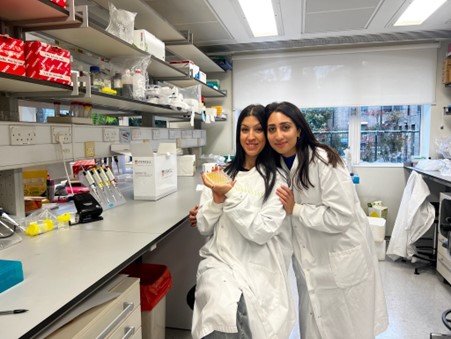
-Rhea, former BSc Translational Respiratory Medicine student
Eligibility
This is a one-year intercalated BSc. To be eligible to apply you must:
- Be registered on a recognised Medical, Dental or Veterinary course at a UK or Irish university or at one of our recognised International Partner institutions.
- Have completed at least one year of that course before you apply to Imperial. i.e. you must be at least in Year 2 in 2025/26.
- Have at least one year of your degree left when you return to your home institution after completing your intercalated BSc.
-
Academic transcript covering your marks (from university) up to and including the 2026-27 academic year. There is no official cut-off for academic performance but students who are accepted onto our courses are generally on track to achieve a 2.1 or higher.
Application Process
The application process for the 2026–27 academic year is now closed and will reopen in early October 2026.
Selection is based on your application form and the supporting documents you will upload with your application. Please find further information about the application process in the Imperial Intercalated BSc Guide for 2026-27 Entry (PDF).
The BSc Translational Respiratory Medicine will run from Monday 21 September 2026 until Friday 21 May 2027. The term dates can be found in the .
If you have any queries about the application process, please email the Faculty Education Office (BSc Team) at feo.bsc@imperial.ac.uk.
Second Round of Applications
Unsuccessful or wait-listed applicants will be given the opportunity to make a second round application to any BSc course with space remaining.
Course Structure
The module consists of 12 weeks, comprising three- 3 week blocks of teaching followed by a consolidation week. Each block focusses on an aspect of respiratory science as outlined below:
Block 1: Global Burden and Clinical Manifestations of Respiratory Disease
Block 2: Lungs and Airways: mechanisms of function and dysfunction
Block 3: Advances in Respiratory Medicine
Highlights include:
-
Journal clubs
-
Data analysis sessions
-
Clinic visits at Royal Brompton Hospital
-
Practical week: Cell culture, experimental design, ELISA, cell viability
-
End of week quizzes
-
Assessment specific workshops
-
Trip to British Thoracic Society Winter conference
Module 2 comprises two separate components. The first is a team-based assessment and the second and individual assessment.
Group literature review
You will be assigned groups to write a literature review in a relevant topic is respiratory science. You will then be asked to critique another team’s article before addressing the reviewers comment on your own article. This is a team-based exercise with guidance from tutors throughout.
Science in Context
From your clinical visits in Module 1, you will select a patient and generate and present an electronic poster describing their pathophysiology and rationale for treatment.
This is a 14-week research project. Projects may be laboratory based, clinical or data driven. You will be given a choice of projects and students choose their preferred projects which are then allocated based on an algorithm. It is important to ensure that your NHS access is maintained so you have the widest choice of projects. Examples of projects offered are below, but these change year on year depending on supervisor preferences and availability.
Projects selected 2025-2026
BSc Translational Respiratory Medicine (TRM) Projects 2025-26
|
Project |
Project Name |
Project Type |
|
1 |
Clinical impact of removing race from lung function equations in determining the eligibility of patients with interstitial lung disease (ILD) for antifibrotic treatment |
Clinical |
|
2 |
ECG changes during COPD Exacerbation |
Clinical
|
|
3 |
Feasibility of 3D printed tracheobronchial models and single use bronchoscope-phone image monitors for self directed home based training in Bronchial navigation / performance skills |
Clinical
|
|
4 |
Obstructive Sleep Apnoea - Mapping Hypoxic Burden profiles in different disease phenotypes. Can we predict Hypoxic burden and what impact? |
Clinical |
|
5 |
Outcomes of patients with interstitial lung disease and severe acute respiratory failure in and beyond ICU: National audit and predictors of ICU admission |
Clinical
|
|
6 |
Predicting lung tumour local recurrence based on ablation zone size and needle position |
Clinical
|
|
7 |
Predictors of diagnostic and therapeutic outcomes from a Bariatric Sleep Service -15 year review from a Single centre Sleep Medicine clinic |
Clinical
|
|
8 |
Analysis of hub genes and pathways that differentiate sputum host immune responses to microbial infection in T2high versus T2low asthma |
Data Analysis |
|
9 |
Assessment of the NICE BTS SIGN algorithm for diagnosis of asthma in children in clinical practice |
Data Analysis |
|
10 |
Compartment-specific analysis of hub genes and pathways that differentiate corticosteroid-responsive versus non-responsive asthma |
Data Analysis |
|
11 |
Investigating different granulocyte and macrophage subtypes in asthma phenotypes including Early- and Late-Onset Severe Asthma and T2 high and T2 low asthma |
Data Analysis |
|
12 |
Investigating the association between lung hyperinflation and cardiovascular disease |
Data Analysis |
|
13 |
Is polycystic ovary syndrome associated with asthma outcomes? |
Data Analysis |
|
14 |
The clinical significance of BNP in patients with pre-capillary Interstitial Lung Disease-Pulmonary Hypertension (PH) and Sarcoid-PH |
Data Analysis |
|
15 |
The role of macrophages in chronic adult-onset severe asthma |
Data Analysis |
|
16 |
Comparing NT-Pro BNP methods in COPD patients and it's association with cardiovascular disease |
Laboratory |
|
17 |
Effect of extracellular vesicles from BEAS-2B cells on fibroblast phenotype |
Laboratory |
|
18 |
Effect of fibroblast derived extracellular vesicles on endothelial cellular senescence |
Laboratory |
|
19 |
Inflammatory profile in asthma exacerbations in severe asthma |
Laboratory |
|
20 |
Sex hormones and lung function |
Systematic Review |
Frequently Asked Questions
- Can I propose my own project for Module 3?
- Can I speak to a current student?
- How are projects allocated?
- How many First-Class degrees are awarded?
- How many places are available?
- What does the timetable look like?
- When will I receive the outcome of my application?
Yes, if you already have established research support and a suitable project proposal. Any such proposal must be discussed with the Module 3 Lead before the course begins to ensure all degree requirements and regulations can be met. Many of the projects offered within Translational Respiratory Medicine provide significant opportunities for students to shape the direction of the work, which is often one of the most rewarding aspects of the research experience. As this may be the beginning of your research journey, the focus should be on developing the skills and experience that will support your future career.
Yes. Please contact the BSc Translational & Respiratory Medicine Course Coordinator, Tamsin Moala (respbscteach@imperial.ac.uk), who will be happy to put you in touch with a current student.
Project opportunities are circulated during Term 1. Students are strongly encouraged to meet with potential supervisors before submitting their preferences. Students may rank up to five project choices, and allocations are made using a best-fit matching process.
The number of First-Class degrees awarded varies from year to year. Every student is supported by the course team and given every opportunity to achieve their full potential. Beyond academic performance, the programme equips students with valuable research, analytical, and critical-thinking skills that can open doors to a wide range of future career opportunities.
There are 10 places available for intercalating students from other universities, who join a cohort of up to 25 Imperial students.
Module 1 is delivered in a hybrid format, typically consisting of three days on campus and two guides online study days per week. Module 2 is largely self-directed; however, students are expected to attend group meetings in person. Attendance requirements for Module 3 will depend on the project undertaken, but students are expected to attend weekly on-campus meetings with the Module 3 Lead.
All applications are reviewed after the application deadline. We aim to notify applicants of the outcome by the end of March.


.jpg)


.jpeg)