
Interviews
Interviews can take various forms in research (ranging from structured or semi-structured to unstructured or informal), and can offer particular strengths and challenges depending on the purpose for which they are being used. Interviews can yield in-depth information and can be particularly useful if you want to investigate experiences, opinions or attitudes, but the process of designing and conducting them requires time and attention, and researchers face a number of different choices during the process (Savin-Baden and Howell Major, 2013, pp. 357 & 371).
"The interview is a flexible tool for data collection, enabling multi-sensory channels to be used: verbal, seen, spoken, heard and, indeed with online interviews, written. The order of the interview may be controlled whilst still giving space for spontaneity, and the interviewer can press not only for complete answers but for responses about complex and deep issues" Cohen, Manion and Morrison, 2018, p.506
VPW
What does an effective introduction look like in practice?
Conducting educational research interviews: Effective Introductions (2’ 55”)
The videos below provide examples that demonstrate both effective and poor practice in interviews, showing what effective introductions, appropriate phrasing of questions, and active listening look like in practice.

What does an effective introduction look like in practice?
Watch the video for examples of effective and poor practice in interviews.
Conducting educational research interviews: Effective Introductions (2’ 55”)
The videos below provide examples that demonstrate both effective and poor practice in interviews, showing what effective introductions, appropriate phrasing of questions, and active listening look like in practice.
How can you use appropriate, non-biased language effectively
Watch the video to discover how using clear and neutral langue can help gather more valid responses.
Conducting educational research interviews: Effectively using appropriate, non-biased language (2’ 24”)
Using examples of effective and poor practice, the following video shows how using clear, neutral language in interviews can help us to gather richer and more valid responses.
What does effective active listening look like?
Watch this video on effective and poor practice in interviews.
Conducting educational research interviews: Effective active listening (2’ 52”)
This video uses examples of effective and poor practice to provide practical guidance on encouraging meaningful participation in interviews.
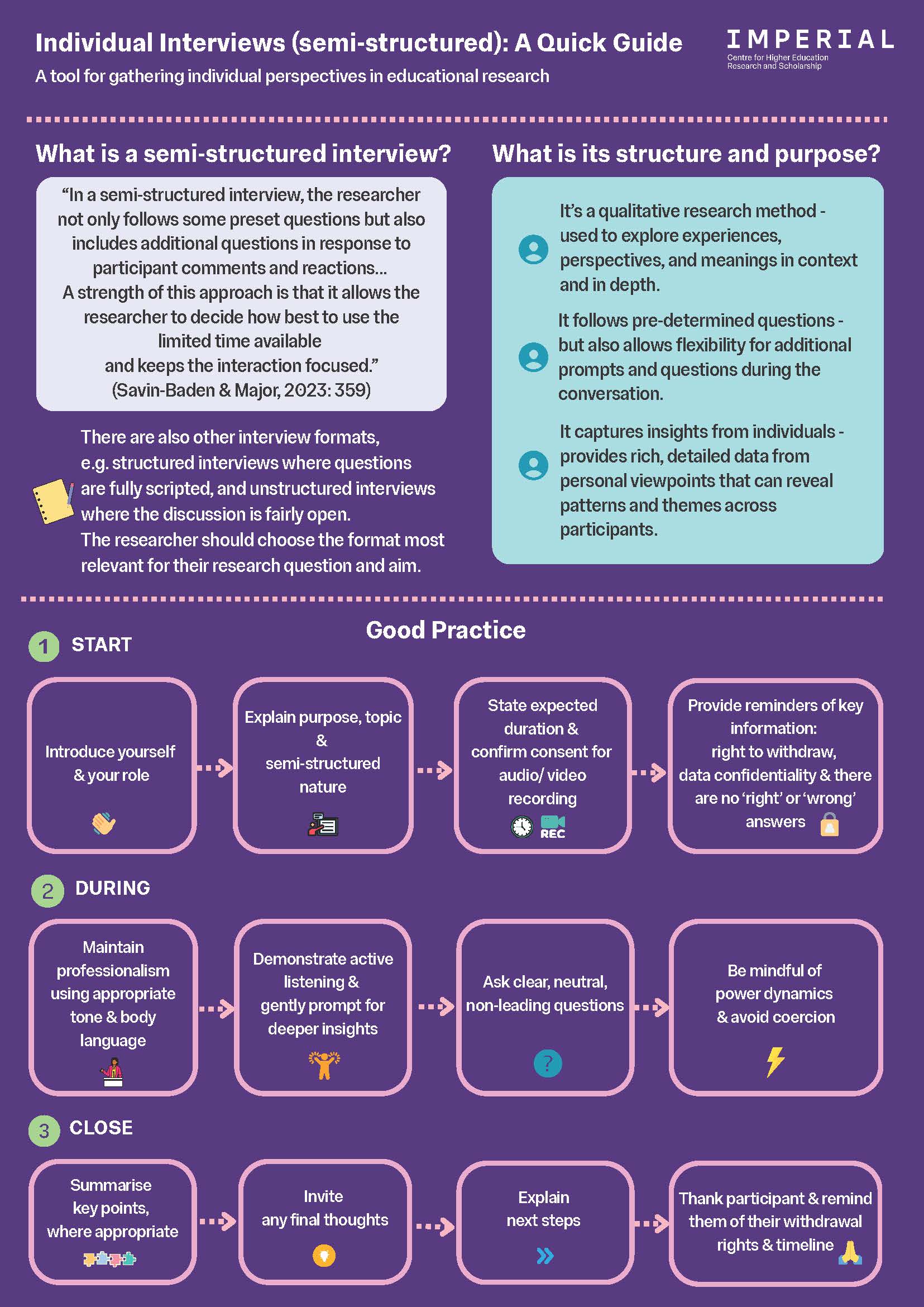 Interviews: A Quick Guide
This individual interviews summary infographic provides a quick guide to conducting semi-structured individual interviews in educational research. It outlines what they are, their structure and purpose, and offers practical guidance on good practice before, during, and after the interview.
Educational research at Imperial
 Dr Toby Athersuch
Lecturer in Environmental Toxicology and Biomarkers
Department of Surgery and Cancer
Faculty of Medicine
'I was interested in understanding better how doctoral students develop and change their identity within complex research environments at the intersection of many "traditional" fields of study. I considered how these students negotiated their learning environments in relation to the idea of communities of practice (CoP).
I needed to gather rich information about learning/research environments of students and chose to use semi-structured interviews. This restricted the number of participants I was able to include which meant that the conversations could be very individual, and avoided being dominated by strong characters. I also asked participants to sketch a diagram of how they felt they fitted in, which provided considerable insight and was useful for developing the discussion.
The 45-min interviews meant a lot of transcription of the audio recording to written text; most transcripts were in the range of 5000-8000 words! Intellectually, the most challenging part was reconciling the contrasting views of students with the existing models of CoP, and exploring how these might be modified.
Other than using a transcription service to sort out the audio to text (!) I would recommend including another element into an interview setting. My choice of requesting a sketch was well received, and very informative; it often helped the students formulate their opinions to my questions.'
 Dr Hannah Beckwith
Renal Registrar
Department of Medicine
'My project [as part of the MEd in University Learning and Teaching] was an exploration of the development of professional identity in postgraduate physicians, using nephrologists as a study population.
The main reason for choosing semi-structured interviews was that there was the potential for sensitive disclosures; as such I felt focus groups were not appropriate. Additionally I wanted to be able to clarify individual points and probe deeper if needed, hence for this project I also excluded a questionnaire-based approach.
I think the most significant challenge for me was time. I chose to self-transcribe - it meant that I got to know my data really well but it took me much longer than anticipated!
The main piece of advice I’d give would be to make sure you have left enough time in your schedule to manage unexpected delays. I don’t think I’d choose to do things differently, but would have definitely set more time aside for transcription and analysis when planning my original timescale.'
Further reading
Cohen, L., Manion, L. & Morrison, K. (2018) Interviews. In: Cohen, L., Manion, L. & Morrison, K. (eds), Research Methods in Education. 8th edition. Abingdon, Routledge.
Savin-Baden, M. & Howell Major, C. (2013), Interviews. In: Qualitative Research: The Essential Guide to Theory and Practice. Abingdon, Routledge.