Enhancing Research Culture and Impact through Imperial Advanced Hackspace
 Advanced Hackspace at Imperial College London is an innovation hub that brings together inventive minds from diverse backgrounds, academic disciplines, and levels of expertise across the College network. Its purpose is to foster collaboration, experimentation, and innovation by providing an inclusive environment where students, researchers, academics, and staff can develop and test new ideas. It is the only place on campus that offers access to a comprehensive range of specialist facilities (electronics laboratories, wood and metal workshops, a bioengineering laboratory, and an extensive suite of prototyping tools and equipment) under one roof. By providing access to these resources, the Hackspace supports the design, development, and realisation of innovative projects from concept through to prototype.
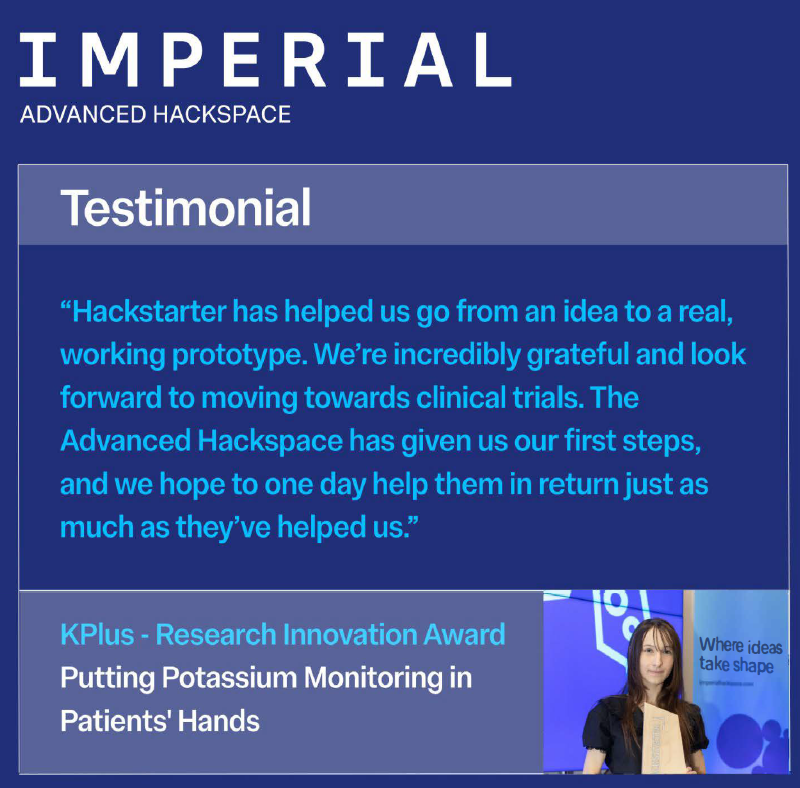
This programme aimed to expand Imperial College Advanced Hackspace’s role in supporting the research environment, with a focus on developing prototyping, promoting entrepreneurial skills, enhancing research impact, and strengthening interdisciplinary collaboration. The core initiative was to participate in the Hackstarter Programme, focusing on ECRs and academics exploring research equipment optimisation and diagnostics. This is also looked to use a proven structured pathway to prototype, test and develop ideas with Hackspace staff support. Further engagement activities connected researchers with each other and with Hackspace expertise to accelerate skills development and help improve research outcomes. The project was undertaken with the following objectives in mind:
- Advance Research Culture by embedding creativity, collaboration, and openness through hands-on innovation and team-based problem solving.
- Empower Researchers to prototype and test research-led innovations that improve research outcomes and foster a sense of ownership and agency.
- Support Career Development by equipping researchers—particularly ECRs—with entrepreneurial and technical skills that enhance research independence and confidence.
- Promote Interdisciplinary Collaboration through facilitated engagement across Faculties and research domains.
- Encourage a Culture of Experimentation through rapid prototyping and iterative design (“fail fast” ethos), promoting resilience and learning.
In total, 24 Hackstarter projects including 10 research-focused projects were supported through this initiative, with dedicated access to workshop facilities and equipment, and expert technical advice from Hackspace Fellows. The programme provided eight weeks of structured support leading up to the Hackstarter final showcase, where participating teams demonstrated their progress and presented their projects to a wider audience. The final event included a pitch competition, with winners recognised for their project development and achievements.
The key activities delivered through this initiative are outlined below:
1. Hackstarter Programme focusing on diagnostics and research equipment
-
-
- Structured support for researchers to develop and iterate early-stage prototypes.
- Access to Hackspace facilities, mentoring, and technical support.
- Events (kick-off launch event, midway progress informal event to enhance collaboration, final showcase event to present outcomes)
-
2. Research Engagement and Culture Building
-
-
- Workshops and drop-in sessions to introduce Hackspace capabilities and facilities to research groups – create a sense of community and informal peer learning and support
- Pilot collaborations between Hackspace staff and research teams on active projects aid trust building and shared understanding.
- Development of case studies demonstrating inclusive innovation, supportive research environments and research impact.
-
 The Datron Neo precision microfabrication machining system, equipment acquired as part of this project, continues to provide Imperial researchers, particularly those working in medical and healthcare research, with direct access to advanced microfabrication capabilities that are not readily available within individual departments. Combined with technical support from Hackspace staff, this has reduced barriers to innovation, enabled greater autonomy in experimental design, and contributed to a more inclusive and sustainable research environment. Located within the Advanced Hackspace, the equipment also facilitates interdisciplinary collaboration and innovation. This is expected to create further opportunities for skills development and knowledge exchange by enabling the rapid development, testing, and refinement of bespoke experimental devices, instrumentation, and proof-of-concept technologies.
The activities have established lasting infrastructure, expertise, and support mechanisms that will continue to deliver benefits beyond the project period, supporting future research, innovation and collaboration across Imperial.