.jpg)
Welcome to your Intercalated BSc at Imperial
Contact us
BSc Programmes Team:
For BSc course-specific queries please contact your BSc Pathway Administrator.
We are looking forward to welcoming you to Imperial for the 2025-26 academic year. This Induction Hub contains useful information to help you prepare for life at Imperial.
Welcome message from the School of Medicine Student Union president
.JPG)
Hey everyone, my name is Sarah, and I am your Imperial College School of Medicine Students‘ Union (ICSMSU) President for 2025-2026!
Firstly, congratulations on joining us here at ICSM - we are so excited to welcome you all into our vibrant community. We have a whole host of wonderful events and societies, and I would strongly encourage you to get stuck into them. Getting involved is truly the best way for you to meet new people and make some friends for life.
We appreciate that joining a new University can be intimidating, but please be assured that the Students’ Union Welfare team and the School of Medicine Faculty Education Office Welfare Team are always here for you should you need them.
You can find out more about what we do on the ICSMSU Website. If you have any queries, please do not hesitate to reach out and find out more about what we do on the School of Medicine Student Union website.
we can’t wait to meet you!
Starting your BSc at Imperial
Please read this important information about preparing to start your intercalated BSc at Imperial.
Useful information
- Meeting the condition of the iBSc offer
- Collecting your Imperial College ID card
- Your timetable
- Welcome Event for Incoming iBSc Students
- Getting to know the students on your BSc
- Pre-BSc Research Skills Course
- ICT resources for new students
The condition of your intercalated BSc offer is that you successfully complete the 2024-25 academic year and arrange for your home university to send your academic transcript or written confirmation that you have passed to our Admissions Team (medicine.pg.admissions@imperial.ac.uk). The deadline to meet the condition of your offer is Friday 22 August.
Please note that this must be sent by a staff member at your home University. Confirmation received directly from students unfortunately cannot be accepted.
Students on a Tier 4 Visa
If you are an overseas student on a Tier 4 visa, we additionally require you to arrange for the Visa Compliance team at your home university to email our Admissions Team (medicine.pg.admissions@imperial.ac.uk) confirming their continued visa sponsorship and grant permission to use your Tier 4 visa to attend Imperial.
Your College ID card is a multi-purpose, personalised identification key for everything you do across campus.
It grants you access to campus buildings, is your library and printing card, and even allows you to get your discount in College catering outlets. Make sure you carry your card with you whenever you are on campus.
Collecting your ID card
You will receive your ID card at the BSc Induction Morning on Monday 22 September. Please make sure you have uploaded your picture via My Imperial at least two weeks before the start of term, failure to do so may delay your student ID card being available. If you can't upload your picture via My Imperial, your picture can be taken at the ID card office.
Replacing lost, stolen or damaged ID cards
If you lose your card during your year at Imperial or it is stolen or damaged, you need to report this to the ID card office immediately. They will deactivate your card and make sure no one is using it fraudulently.
The first time this happens, the ID card office can replace your card free of charge. Any time afterwards, you'll be charged £10.
Please find additional guidance on the ID card page of the Imperial College website.
ID card office opening hours
The South Kensington ID Card office is open from 09.30 to 13.30, Monday to Friday on the ground floor of the Sherfield Building.
If you have any questions, please contact id.card@imperial.ac.uk
You should receive your Autumn term timetable 2 weeks before the start of term. If you have any queries regarding your timetable you can contact your BSc Pathway Administrator.
Your timetable will be pushed into your Imperial Outlook account calendar using a timetabling system called CELCAT.
Please find information about term dates in the .
iBSc Welcome Event
On Tuesday 16 September from 14.00 to 16.00 there will be an online welcome event for intercalating students which will include an introduction to life at Imperial, talks from past intercalating students and an opportunity to meet your BSc Course Director.
You will receive a calendar invitation for this event at the end of August
Please find the event schedule for the Welcome Event for Incoming iBSc Students.
iBSc Welcome Event
On Tuesday 16 September from 14.00 to 16.00 there will be an online welcome event for intercalating students which will include an introduction to life at Imperial, talks from past intercalating students and an opportunity to meet your BSc Course Director.
You will be contacted over the summer with further information and a calendar invitation to join the event.
BSc Cohort Connect
BSc Cohort Connect is a buddy scheme where new intercalating students and internal Imperial medical students are matched based on shared interests. Students are usually matched in groups of 3 or 4 based on shared interests.
We hope that you get involved in this scheme and have a great experience starting at Imperial. You will receive sign up details by email in September.
Imperial College School of Medicine Student Union clubs and societies
While you are at Imperial we recommend that you get involved with the ICSMSU clubs and societies, as well as attending some of the great events they put on throughout the academic year. More information can be found on the ICSMSU website.
A Pre-BSc Research Skills Course has been developed to help you prepare for your BSc and get you up to speed on the research skills you will need for BSc assessments. You will be sent the link to the course at the start of September.
The course modules include:
- Reading Science
- Scientific Methods
- Interpreting Science
- Communicating Science
Please find information about ICT systems at Imperial in the ICT resources for new students. This page includes guidance on:
- How to activate your College account
- How to set up your email account
- How to connect to Imperial WiFi
- Where you can use computers on campus
- How to contact ICT if you need help
BSc Modules and Assessment
 BSc Induction morning
Monday 22 September (AM)
Module 1 – Taught Component
Monday 22 September – Friday 12 December (12 weeks)
- In this module, you will gain BSc specialism-specific knowledge and skills.
- The module is split into three 4-week blocks. Three weeks of each block will be face-to-face teaching and the fourth week of each block will be a consolidation week.
- Face-to-face teaching will be supplemented by online teaching materials in a flipped classroom approach, allowing you to practise critical questioning and thinking.
- The consolidation weeks give you the opportunity to pause, reflect, revise, prepare, undertake in-course assessment tasks, and receive feedback.
 Module 2 – Self Directed Learning and Group Work
Group Literature Review |Science in Context: Monday 5 January – Friday 30 January (4 weeks)
This module aims to provide you with a collaborative experience of working with your peers to provide a critical synthesis of a scientific problem.
It aims to:
- Enable you to seek and use published data.
- Train you to assess literature, consider caveats and draw appropriate conclusions.
- Teach you to communicate experimental strategies, results and conclusions effectively and succinctly.
- Provide opportunity to participate in the processes of article submission, peer review and rebuttal.
- You will also work independently on a case-based learning task to understand and critique evidence-based practice combined with personalised medicine preparing you to be able to critique the evidence base of your future medical practice.
 Module 3 – Research Project
Monday 2 February – Friday 22 May (14 weeks)
This module will enable you to plan and perform supervised research resulting in a project write-up in the style of an academic research paper. It will also include a critical reflection on your research journey.
- Project title allocation normally takes place between November and December.
- You will have the opportunity to choose from a wide variety of supervised research projects, including laboratory-based, and clinical-based projects.
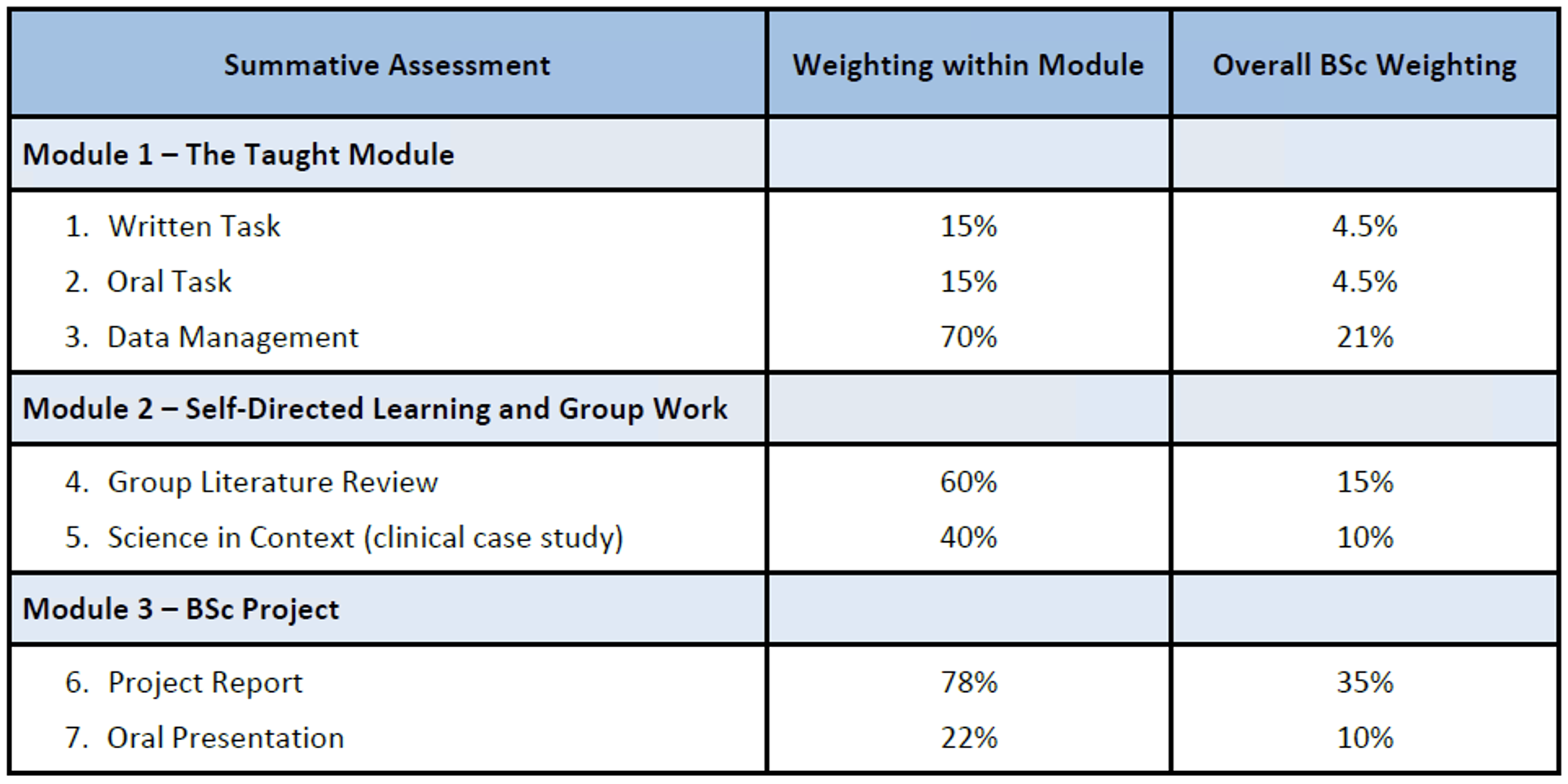
With the exception of BSc Humanities, Philosophy and Law, which has a different assessment structure, all BScs are assessed via 7 items of summative assessment. Please find the BSc mark breakdown below:
BSc Mark Breakdown
Meet the Team
We are the central BSc team and we work across all intercalated BScs at Imperial. In addition, you will have a Course Director, Course Administrator, and Module Leads who are specific to your BSc course. You can find out more about your BSc course team on the BSc course web page.
Your BSc team
Dr Fiona Culley
/prod01/channel_3/media/images/people-list/Fiona-C-square.png)
Dr Fiona Culley
Head of Year
Mike Wilson
/prod01/channel_3/media/images/people-list/mike-square.png)
Mike Wilson
Head of Assessment
Paula Fortune
/prod01/channel_3/media/images/people-list/Paula-square.png)
Paula Fortune
BSc Programme Officer
Janice Pires
/prod01/channel_3/media/images/people-list/Janice-square.png)
Janice Pires
BSc Programme Administrator
Deepak Barnabas
/prod01/channel_3/media/imperial-college/medicine/study/undergraduate/intercalated-bsc/Deepak-.jpg)
Deepak Barnabas
Digital Education Transformation Fellow
Campus information
Each BSc will be based on a particular campus. PDF maps of each campus are available on the Imperial website. Below is a list of our main teaching campuses and which pathways are based on which campus.
Campus information


3 column block - Royal brompton/Charing cross/CX


Your Student Welfare
Personal tutors
You will be allocated a Personal Tutor when you join Imperial. The role of a Personal Tutor is to provide support to students. Academically, this can involve reviewing assessments and other feedback, providing career advice and writing references. Pastorally, your Personal Tutor should be your first line of approach for guidance and advice if you are experiencing any personal issues or problems affecting your studies. You will be invited to meet with your Tutor each term.
Senior tutors
All students have access to a Senior Tutor who is available to provide confidential support with any serious welfare concerns. The Senior Tutor can also make referrals for you to the Health Centre, the Imperial Disability Advisory Service and the Student Counselling and Mental Health Advice Service.
Senior Welfare Tutors
Prof Roshni Patel - BSc senior Welfare Tutor (A-H)
/prod01/channel_3/media/images/people-list/Roshni-square.png)
Prof Roshni Patel - BSc senior Welfare Tutor (A-H)
Dr Christopher John - BSc Senior Welfare Tutor (I-Z)
/prod01/channel_3/media/images/people-list/Chris-square.jpg)
Dr Christopher John - BSc Senior Welfare Tutor (I-Z)
Further useful information
There are a variety of online learning platforms that you will use in your BSc:
Insendi:
Insendi is our main learning platform. You’ll use it to access course materials, participate in discussions, complete assignments, and stay up to date with your coursework.
Panopto:
Panopto is used to record live teaching sessions. You’ll be able to watch lecture recordings at your convenience, which can help you review material and catch up if you miss a class.
CELCAT:
Your class timetable is managed through CELCAT. It automatically syncs with your Outlook calendar, so you can easily keep track of your schedule and stay organized.
MedLearn:
Each student has a dashboard on MedLearn where they can access important information, including BSc guidelines, assessment guidance, marks and welfare resources, including the option to book appointments with your Personal Tutor. Students also submit absence requests and leave reports via MedLearn and can apply for assessment extensions or mitigating circumstances.
We will provide further information about these platforms at the iBSc Welcome Event.
OneDrive:
All students with an Imperial email address have access to OneDrive. Access will remain available for three months after you finish your BSc.
OneDrive is a cloud-based storage platform provided by Microsoft. It allows you to store files securely online, with the ability to access them from multiple devices.
You can write your assignments directly in OneDrive, where work is saved automatically to prevent data loss. Files can also be easily shared, which is useful for group projects.
Attendance at all structured teaching in your BSc is compulsory and 100% attendance is expected, except where a request for leave has been granted or you are absent for health reasons. Please read the School of Medicine Attendance Policy on MedLearn when you start your BSc for further information.
Absence Reporting
To register absence due to illness of up to 7 calendar days, GP or other medical appointments, you will need to complete the absence log form on MedLearn.
If you are ill for more than 7 days or suffering from a chronic illness, in addition to completing the online log, you should speak to your Personal Tutor and your Faculty Eduction Office (FEO) Programme Officer/Administrator. For periods longer than 7 consecutive days including weekends, supporting documentation is required e.g. doctor’s letter.
Requesting leave
If you wish to request a leave of absence for any reason other than illness (e.g. for family event or sporting or other extracurricular activities) you should do so in advance, by submitting a leave request on the same form used to report absences. This will be seen by your Programme Officer/Administrator who will liaise with your BSc Course Director.
Please note that, except in exceptional circumstances, a maximum of 3 days is allowed in any one academic year.
Please be aware that although the School of Medicine is very supportive of students participating in extra-curricular and sporting activities we do expect all students to put their medical studies first.
Intercalating students may be entitled to the receive the Imperial College Bursary. More information can be found on the Imperial Bursary web page.
You will be given the opportunity to loan an iPad for your year at Imperial. The iPad will need to be returned at the end of the academic year.
In July we will send you an iPad form to let us know whether you would like to receive a College iPad. We will ask you to complete the form by the end of August.


