The Application Process
This page explains the undergraduate medicine application process at Imperial and the steps you will need to undertake on your journey to your medical career.
Make sure you learn more about Widening Participation at Imperial College School of Medicine when you start your application process, as there may be specific deadlines for you to provide additional information to support your contextual application.
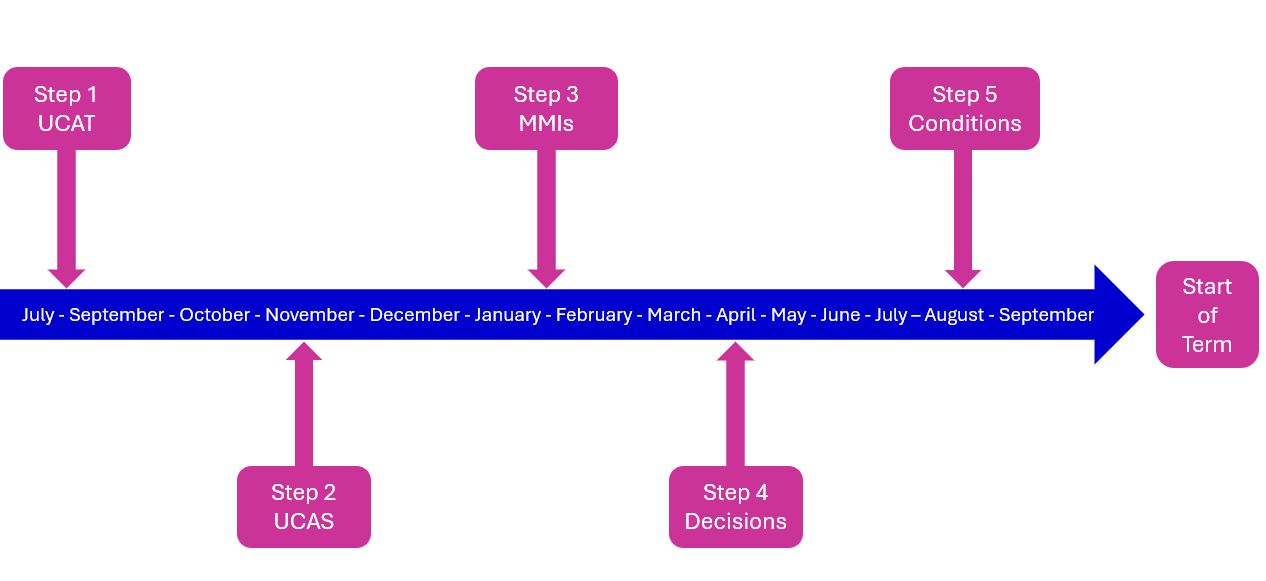
Make the best out of your application
- Step 1: The Admissions Test (UCAT)
- Step 2: UCAS Application
- Step 3: Multiple Mini Interviews
- Step 4: Admissions Decision
- Step 5: Fulfilling the conditions of your offer
Since 2025, the School of Medicine has used the University Clinical Aptitude Test (UCAT) and our academic eligibility requirements to shortlist for interview. Threshold scores will vary year to year depending on the distribution of scores in each cohort of applicants and the ratio of applicants to places.
UCAT testing typically takes place between July and September, before you can submit a UCAS application. Make sure you visit the UCAT website and make a note of registration opening dates and other key deadlines, as well as for details of the test itself.
You can also visit our bespoke UCAT page, created by our students, to help you to prepare thoroughly for your test.
The next step of your application is apply to UCAS by the deadline. The UCAS website has all the information you need, including the application deadline, which is normally around 15th October each year. Make sure you submit all the documents needed for your application. We will look at your predicted grades and your reference, as well as your personal statement and work experience. For more information about entry requirements you can have a look at the MBBS prospectus page.
Personal Statement
Your personal statement is your chance to tell us about yourself. Remember that we only know what you tell us, so make sure you include the things that make you stand out. We are interested in your qualities, skills and interests and why you would be a good doctor. Think about the qualities that make a good doctor and show us how you reflect upon them.
Our main advice is to be honest, specific and concise - exaggerating your work experience or achievements will not necessarily put you ahead of other students. Describe and reflect upon the real experiences you have had, even if things did not go to plan. Give specific examples related to a career in medicine, and make sure you always show how you meet the non-academic criteria of the medical school you are applying to.
Listen to Dr Heather Lewis' advice on writing a personal statement for Medicine.
Work Experience
Work experience is an important aspect of your application. Through reading about your work experience, we can assess whether you possess the reflection skills which will be essential to your role as a doctor. We would like your work experience to show that you understand what a career in Medicine involves - including its challenges - and to demonstrate your interest regardless of these challenges.
We understand that it can be difficult to obtain work experience, or even a volunteering position, in healthcare settings. Looking very early should help, as well as being proactive and contacting a wide range of places, for example: voluntary service departments at local hospitals, local GPs, care homes, disability centres, and/or hospices. Of course, your work experience does not have to be in a healthcare setting in order to be valuable, or beneficial to your application. Look for other opportunities as well, as what you learn from the experience can be even more important than where it is.
During your work experience, make sure you keep a flexible and open approach. The harder you work and the more adaptable you are, the more you will take out of the experience. Make thorough notes, so you can remember and reflect upon your experience later on and closer to your interview. Have a look at our Work Experience page for more information.
Online resources can give you valuable insight into working in the healthcare sector and outline the wide range of careers and courses available. Sometimes, you can even undertake virtual calls or training that might help you understand clinical settings. We recommend you have a look at the following websites for ideas and support:
- The Royal College of Practitioners offer top tips for students aged 16+ who are interesting in obtaining GP work experience, as well as how to make the best of this experience. For those in the UK seeking virtual work experience, Observe GP is also available.
- Medical students also have to show they can work will all sorts of different groups of people and volunteering is a great way to prove this. Talk to your school or college about where to find local volunteering opportunities or visit the Imperial Careers Service Volunteering website for more ideas.
- NHS Health Careers website
- Working in Health YouTube Channel
Those who meet the UCAT cutoff score for the year in which they have applied will be invited to take part to our Multiple Mini Interviews (MMIs). MMIs are typically held throughout January and February. We have a dedicated MMI page that will tell you everything you need to know about MMIs and how to prepare for them.
This is the stage at which we will communicate the outcome of your application. This will be communicated only through UCAS.
Offers
Your offer can be:
- Conditional - most offers are Conditional Offers. This means that you will be able to start the programme if you fulfil certain conditions. For example, achieving the required grades for entry.
- Unconditional - this is typically for candidates who have already obtained their A-level results and don't have any other offer conditions to meet, such as students who have taken a gap year.
Contextual Offers
At Imperial we welcome diversity and want to ensure that our application process is fair to everyone. We use UCAS data to apply a Widening Participation flag to qualifying applications. At any point during the application process, you can let us know if your circumstances change or if you believe you are a candidate for Widening Participation. You can read more about contextual data and admissions schemes.
Rejections
If your application is rejected, there are still options available to you. We receive a high number of applications each year and competition can be very high, but we always offer feedback on the interview process. We welcome reapplications for the next academic year, and we have a webpage dedicated to gap years, with tips on how to make the best use of this time.
You made it: you have an offer! Now you have to make sure you fulfill the conditions of your offer in time to start in October. Make sure you attend all the Offer Holder events, and study hard for your exams so you can achieve the grades you have been predicted.
Your grades will be usually communicated to us via UCAS automatically if you have sat your exams at a UK school or college. However, if you are independently sitting your assessment or are required to provide your qualification results (you will be told if this is the case), these must be sent directly to medicine.ug.admissions@imperial.ac.uk
You can find out everything you need to know here on our submit your offer conditions page.