
Hands-on learning in the ABB control room.
Welcome to the Carbon Capture Pilot Plant
In today’s rapidly changing global industrial environment there is an increasing demand for high calibre chemical engineers with a deep understanding of process engineering, an appreciation of real world plant operations and the passion to engage in the global challenges of the 21st century such as energy and climate change.
Here at Imperial, in our ChemEng educational facility, we strive to address the increasing global demand for talented IChemE award-winning chemical engineers by developing dynamic young engineers using our new world-class teaching and research facilities, including one of the world's most advanced carbon capture pilot plants.
Carbon capture widget
Pilot Plant
Stretching over four floors, the carbon capture pilot plant is at the centre of the Department of Chemical Engineering, providing a fully hands-on discovery experience for students and researchers alike.
Built to the highest industrial standards, our plant is a core part of the training we provide to all our young chemical engineers. It typifies many of the features that graduates will encounter in the ‘real world’, and gives them skills that will be essential in their future careers.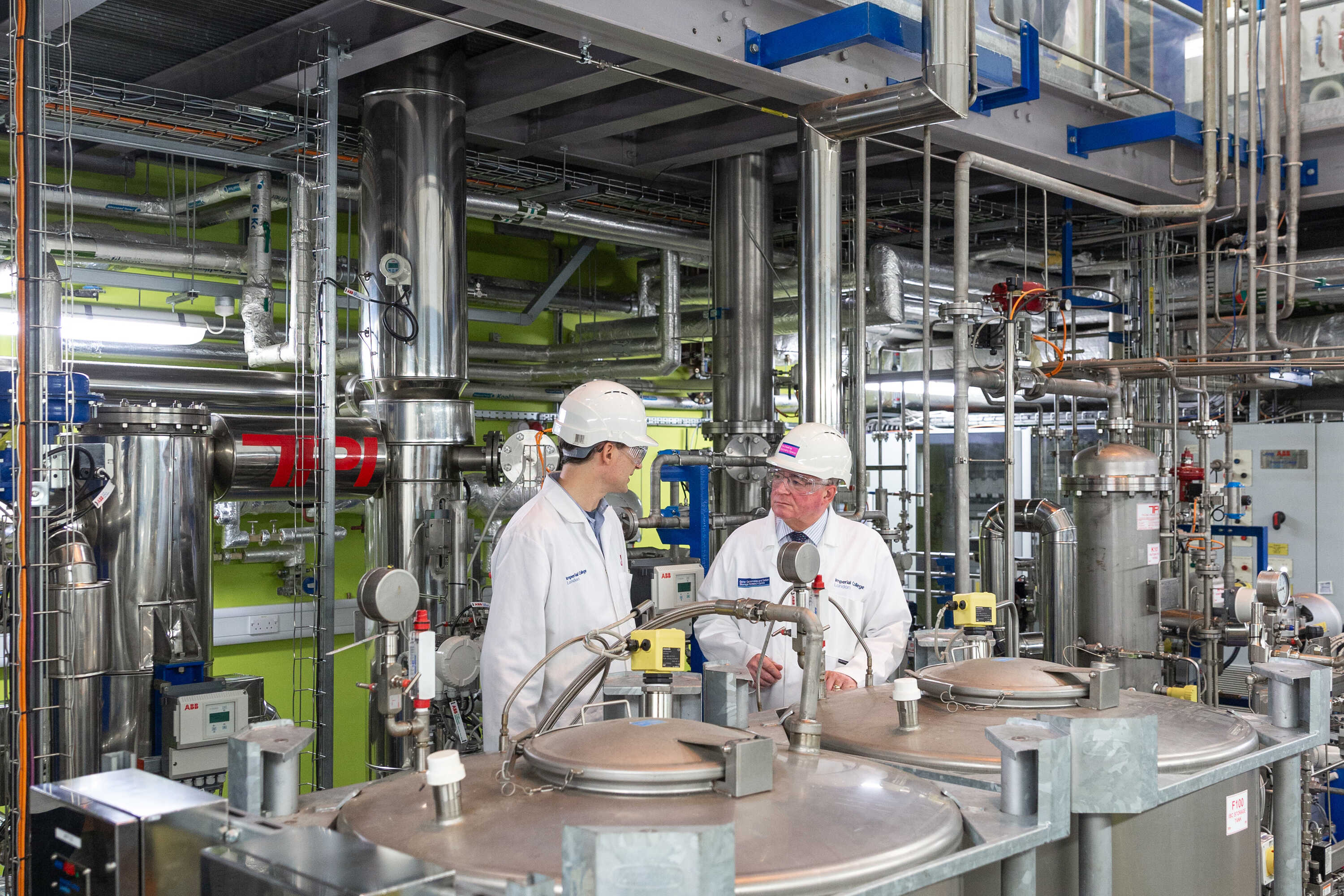
Our futuristic carbon capture pilot plant is also a vital resource in the fight against climate change, demonstrating best practice in capturing and storing harmful carbon dioxide (CO2) before it can be released into the atmosphere.
We actively encourage leading industrial organisations to use our facility for research purposes, with the hope that one day the technology will be adopted on a much larger scale at power stations across the world, capturing CO2 emissions before they harm the planet.
ABB control room
The show-stopping ABB control room is the centre of the carbon capture pilot plant, giving students the opportunity to gain hands-on knowledge that will be crucial in their future careers.
Created as part of a new ten year strategic alliance with ABB, the state-of-the-art facility gives undergraduates the chance to control our industrial-standard Pilot Plant, learning key skills such as how to start up the facility, shut it down as well as operate it safely and efficiently.
As a result of this training, our students graduate from university with an unrivalled expertise, making them more employable in an increasingly competitive sector.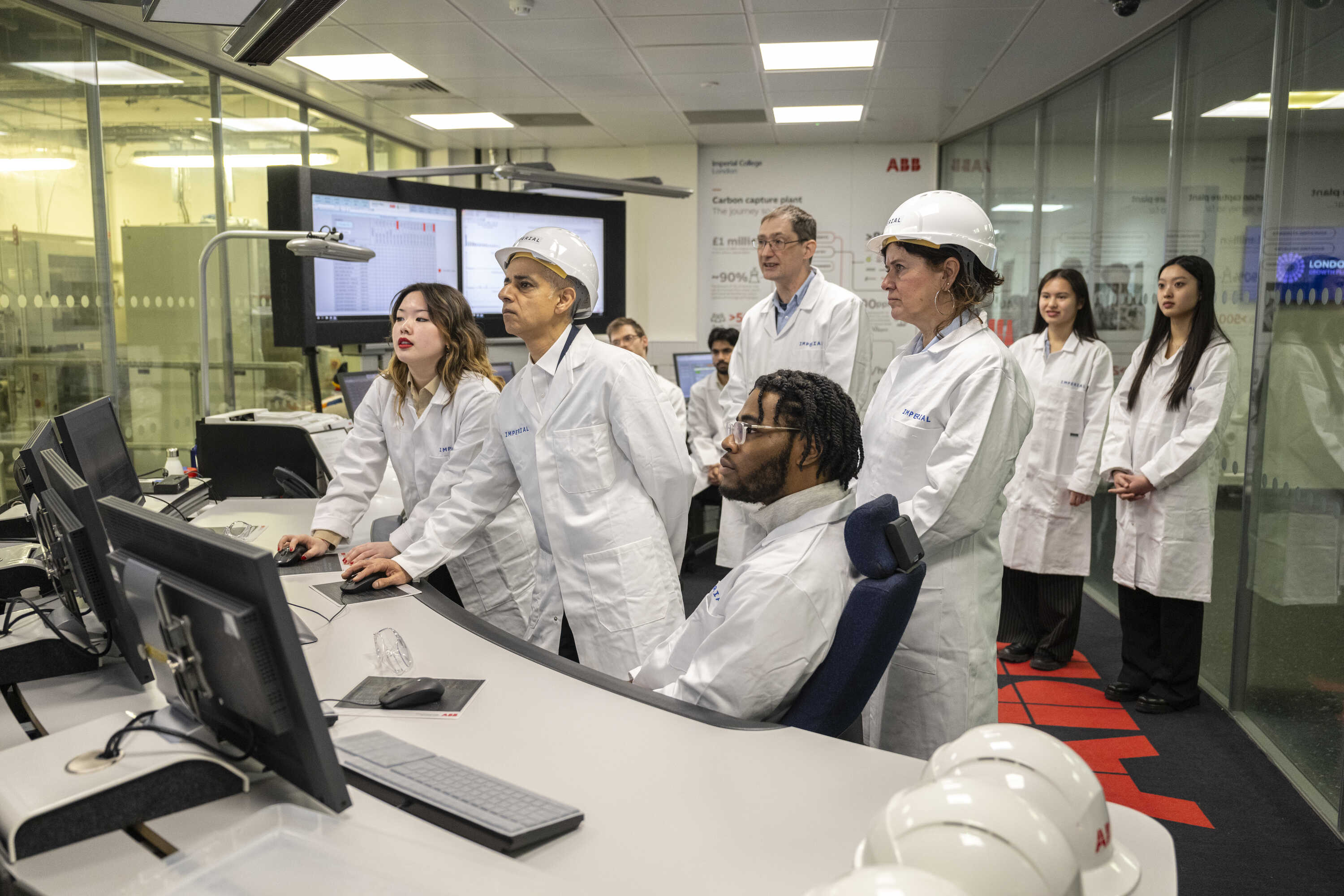
Tomorrow's technology...today
Advanced technology plays an important role in the ABB control room, and over two hundred ABB industrial instruments are installed in the pilot plant so that students can measure process critical variables such as pressure, temperature, flow rate, pH, liquid level, pump speed and motor speeds.
Several web cams are installed around the facility, with the feeds from these displayed on screens in the ABB control room alongside the main graphical process interface.
Students are encouraged to use Apple iPads® in the Pilot Plant, and with each device linked to the central console screens, they can refer to the plant’s schematics at the touch of a screen, as well as remotely control or monitor its operation in real time.
Our exciting Summer School programme within the Carbon Capture Pilot Plant is a specially designed educational course that allow students to expand their knowledge outside traditional term time and has been specifically constructed for groups from overseas academic institutions.
Three week programme: Carbon Capture Theory and Pilot Plant Operation
Now in its seventh year, this short course has been specifically designed at the request of one of our regularly attending universities to meet the needs of students to work hands-on with our centrepiece facility, the Carbon Capture Pilot Plant.Spread over a highly intensive period of study for three weeks students will in the first week of studying theory, be taken on a highly-paced resume of process analysis, transfer processes, separation processes, process dynamics and control and given learning tasks.The following two weeks will be devoted to learning and thinking on their feet inside the pilot plant, taking health and safety instructions, walking the P&IDs, discovering over 250 instruments, starting up and controlling the Plant, reacting to emergencies and working in real life teamwork situations. Students will also receive social and cultural activities.
Dates
For invited institutions only (not individuals), this highly popular short-course for 2025 now has two dates:
-
Monday 21 July - Friday 8 August
-
Monday 4 August - Friday 22 August
Your experience with us
This Summer School programme is provided to juniors and seniors studying chemical engineering and comprises a tight and demanding schedule combining team exercises and a full hands-on Pilot Plant experience.Young chemical engineers will enjoy an outstanding training experience in our state-of-the-art carbon capture pilot plant and its ABB Control Room, which will equip them with unique expertise for their future careers in the industry.There will also be an opportunity to take guided visits around a number of cultural and historical sites in and around London. Students also enjoy exploring the rest of the UK and Ireland, and, as London is the gateway to Europe, they may make the most of their free time to go exploring further afield.
Contact information
The course is coordinated by Professor Daryl Williams and Mr Clive Rodgers. In the first instance please email c.rodgers@imperial.ac.uk.
Please note that all of our Summer School programme is for block bookings by institutions only, subject to agreeing our contract terms and conditions, and we are unable to accept applications from individual students.
Applications | further information
1) Application details
- Summer school fees
2025 tuition fees: all payments to be made in £GBP*
Three-week course: Comprising one module of theory to ensure that all students are at the same learning stage, two modules of eight Pilot Plant sessions.
Fee: £3200 (circa US$ 4390 | RMB 31,467 **
*Invoice to institution will be made out.
** £GBP is fixed but US$/RMB is indicative only and may alter according to currency fluctuation before the start of the course. - Getting to the UK and visa arrangements
We will be pleased to assist you with advice but travel or visa arrangements are not included within our fees.
All information is correct at August 2025 and to ensure that this is as up to date as possible for you, we reserve the right to amend this information from time to time. Please monitor these pages.
2) Accommodation
Accommodation and meal plans are not included within the fees.Institutions or individuals may choose to make their own arrangements or we can assist with this for you, but early bookings are advised which will also give best prices. Please note that as London is the capital of the UK it is a highly desirable location - summer accommodation is in high demand and should be booked quite early.
For 2025 we will be offering our own Princes Garden accommodation, on campus. Please refer requests to Clive Rodgers.
3) Course syllabus
Institutions are encouraged to supply their own teaching staff to co-teach, as well as taking a lead role in student assessment, noting that we do not offer UK/international credits.
4) Who to contact
Please contact Clive Rodgers by email: c.rodgers@imperial.ac.uk who will be very pleased to discuss your particular requirements for your summer school with us here in London.
Please note that our Summer School programme for 2025 is for block booking by invited institutions only who have agreed to our contractual terms and conditions.
Regrettably we are unable to accept applications from individual students.
Learning outcomes for the Carbon Capture Theory and Pilot Plant Operation course
By the end of the course students should be able to:
- understand the basic transport and separation processes occurring in the plant for separating carbon dioxide from nitrogen;
- develop an understanding of the relevant theory behind the operation of the pilot plant (e.g. principles of heat transfer, mass transfer, gas-liquid equilibrium) and be able to critically compare theory to real plant measurements;
- identify key plant components (process equipment, instrumentation and control systems) and be able to describe how they work;
- understand the effect of controllable system parameters on plant performance and how to measure, control and evaluate plant performance;
- relate P&ID representations to physical plant – practice ‘line walks’;
- compile iInstrument input/ output lists;
- be able to prepare start-up and shut down instructions for operating the plant in a safe and efficient manner, taking into account that during transient conditions chemical plants are less safe than when they operate at a steady state;
- participate in shift change-over during operation;
- transfer critical operational information verbally during a shift changeover;
- understand the effect of controllable system parameters on plant performance and how to measure, control and evaluate performance, and be able to plan a set of relevant experimental runs to collect the required data;
- analyse and present experimental data in a clear, concise and coherent form in the form of a brief report;
- work effectively and efficiently within a team to achieve a complex goal.
Previous Summer School Groups
Please see below a short collection of student views from the summer school programme:
All Imperial staff were extremely helpful to me. They made all of us feel very welcome. I have always wanted to study abroad. Imperial is a great school with excellent facilities and I was looking forward to a hands on learning experience. This has been an outstanding opportunity for me.
I would recommend it because I think it is an extremely valuable experience, both to receive such a great deal of information and schooling, as well as be immersed in the culture of London.I would recommend it because I think it is an extremely valuable experience, both to receive such a great deal of information and schooling, as well as be immersed in the culture of London.
I decided to come to take meaningful chemical engineering courses over the summer while still being able to have an international experience. I expected a challenge but also a lot of enjoyment from the course.
Summer school social events
There are several social events organised for the students, including 5-a-side mixed soccer, evening get-togethers, lunches and dinners with the Imperial College staff and students.
Two one-day leisure trips are organised (a coach tour to ancient Stonehenge, Roman Bath and Royal Windsor Castle and a London Thames riverboat cruise to The Tower of London and Royal Greenwich).
Dr Colin Hale
Course Leader. Colin also oversees all activities, commercial and non-commercial, in the Pilot Plant.
Email: c.hale@imperial.ac.uk
Clive Rodgers
Summer school lead.
Email: c.rodgers@imperial.ac.uk
Telephone: +44(0) 7966 211916
Hannah Davy
Summer school administrator, working closely with Clive to ensure the most effective experience.
Email: hannah.davy@imperial.ac.uk
Telephone: +44 (0)20 7594 6053