
We have a range of committees to ensure departmental priorities are aligned, taking into consideration the broader climate within which we operate, including Imperial's strategy, 'Science for humanity'.
Committee list
- Analytical Services Users Group
- Awards committee
- Computing Services User Group
- Equality, Diversity and Culture Committee
- Enterprise Committee
- Executive Committee
- Postdoc Committee
- Research Committee
- Rewards and Recognition Committee
- Strategic Advisory Board
- Sustainability Committee
- Taught Course Committee
Terms of Reference (ToR)
The role of the Analytical Services User Group (ASUG) is to:
- Review the balance of capabilities (equipment wise) versus the (evolving) Departmental needs and strategy.
- Support the preparation of the annual budget in line with the more strategic approach.
- Propose equipment to be acquired/replaced in line with the (evolving) Departmental needs and strategy and report to the Research Committee and the Director of Resources for review of the proposal.
- Review the operational strategy of the Analytical Services.
Members - Chris Tighe (Chair, Associate Professor)
- Patricia Carrry (Head of Chem Eng Analytical Services)
- Qilei Song (Associate Professor)
- Yuval Elani (Associate Professor)
- Ceri Hammond (Associate Professor)
About
The Department has established an Awards Committee to ensure that all opportunities are taken up to recognise the excellence of staff and students and consolidate the process carried out in the past by other groups such as the Research Committee. The Committee will need input from other groups via representatives on the Committee.
Terms of Reference (ToR)
- Identification of awards and bursaries (undergraduate, teaching, research, admin and support) and deadlines.
- Maintenance of database/spreadsheet along with previously nominated candidates.
- Identification of suitable candidates (e.g. through personal tutor, line manager, supervisor).
- Conducting an internal selection process when required.
- Co-ordination/optimisation of submissions (e.g. commenting on personal statements, getting an effective letter of support from an appropriate staff member).
- Feedback to interested candidates who were not put forward that year.
- Identification of future candidates and development of personalised action plans.
Keeping track of successes and ensuring they are communicated.
Members
- Krishnan J (Reader in Biological&Chemical Information Processing Systems) - Chair
- Omar Matar (Head of Department)
- Anusha Sri-Pathmanathan (Director of Operations)
- Camille Petit (Director of Research)
- Jerry Heng (Director of Undergraduate Studies)
- Andreas Kogelbauer (Director of Course Operations)
- Jana Pierron (Sargent Centre Manager)
- Leah Grey (Administration and Staffing Manager)
- Cleo Kontoravdi (Director of Postgraduate Studies)
- Sandro Macchietto (Director of Enterprise)
- Daryl Williams (Professor of Particle Science)
- David Owen (Academic Administrator)
About
This committee exists to ensure that computing hardware and software remain state-of-the-art and to plan for future computing needs.
Terms of Reference (ToR)
- Ensuring that computing hardware and software remain state-of-the-art.
- Interface with the Research Committee.
- Interface with College ICT.
- Manage the Departmental computing budget.
- Plan for future computing needs.
Members
- Serafim Kalliadasis (Professor in Engineering Science & Applied Mathematics) - Chair
- Graham Stuart (Head of computing services)
- Terrence Crombie (Research Computing Analyst)
- Camille Petit (Director of Research)
- Cleo Kontoravdi (Director of Postgraduate Studies)
- Jerry Heng (Director Undergraduate Studies)
- Andreas Kogelbauer (Director of Course Operations)
- Nina Thornhill (Director of PAIC MSc)
- Claire Adjiman (Professor of Chemical Engineering)
- Benoit Chachuat (Professor of Process Systems Engineering)
- Gonzalo Guillen-Gosalbez
- George Jackson (Professor of Chemical Physics)
- Erich Muller (Professor of Thermodynamics)
- Yun Xu (Professor, Biofluid Mechanics)
About
Our Equality, Diversity and Culture (EDC) Committee is a dedicated team whose role is to actively maintain and develop a positive culture, and to identify opportunities to raise awareness of Equality, Diversity and Inclusion across the Department.
Terms of Reference (ToR)
The committee actively engages students and staff with maintaining and developing a culture that supports a good work life balance that is supportive and respectful of all. It also exists to identify potential equality, diversity and departmental culture issues.
Co-Chairs:
- Omar Matar (Head of Department) – Co-Chair
- Yun Xu (Professor, Biofluid Mechanics) – Co-Chair & Academic Lead
- Leah Grey (Administration and Staffing Manager) – Co-Chair & Administrative Lead
Members:
- Anusha Sri-Pathmanathan (Director of Operations)
- Avery Kitchens (Executive Assistant)
- Navta Hussain (Communications Manager)
- Skyla Morrison (Events, Communications and Staffing Administrator)
- Deesha Chadha (Senior Strategic Teaching Fellow)
- Andreas Kogelbauer (Director of Course Operations)
- Anna Hankin (Outreach Champion)
- Patricia Carry (Head of Analytical Services)
- Oscar Mercado Valenzo (Research Associate in Peptide Chromatography)
- Yuval Elani (Associate Professor in Biochemical Technologies)
- Ahmed Almusawy (Taught Postgraduate)
- Nadin Moustafa (Research Associate in Carbon Dioxide Removal)
- Antonio Del Rio Chanona (Associate Professor)
Postgraduate Reps:
- Emma Pajak (Research Postgraduate)
- Laura Heckles (Research Postgraduate)
PhD Student Reps:
- Ejdi Xhebraj (PhD Student)
- David Büchner (PhD Student)
MSc Student Reps:
- Jinan Algifari (MSc Student)
- Lina El Eulj (MSc Student)
UG Student Reps:
- Alice Zhu (UG Student)
- Amogh Krishnanand Atreya (UG Student)
About
The Enterprise Committee's objective is to establish and embed “translation” across the Department of Chemical Engineering, and to have it recognised on par with teaching and research, so as to maximise its potential and impact.
Terms of Reference (ToR)
- To promote translation activities in the department, in collaboration with the Strategic Advisory Board Committee and the relevant Imperial Enterprise and Faculty of Engineering teams
- To gather and analyse data regarding translation activities and performance of the Department, and (where data are available) relative to other departments at Imperial and elsewhere, and produce a yearly summary
- To provide a framework for advising on impact via commercialisation or open-source/public domain activities (and if the latter, then through which mechanisms in order to maximise exposure and visibility etc.)
- To organise “Dragon’s Den” style presentations of proposed projects to the Strategic Advisory Board Committee (and/or other agreed internal or external events)
- To manage the department Pre-Seed Fund (arrange calls, presentations, evaluation criteria and evaluations, selection of candidates for the support programme, monitoring)
- To publicise, and, where useful, arrange, relevant educational activities (e.g. on licensing, technology transfer, entrepreneurship events, Alumni visits, etc.)
- To liaise with the Departmental Exec, Teaching, and Research Committees on relevant matters
Members
- Prof Sandro Macchietto (Director of Enterprise) - Chair
- Prof Camille Petit (Director of Research)
- Geetanjali Bathina (Enterprise Program Manager)
- Andrea Bernardi (Research Fellow member)
- Prof Jason Hallet (Academic member)
- Navta Hussain (Communications Manager)
- Prof Omar Matar (Head of Department)
- Sarah Payne (Secretary to the Committee)
- Prof Ronny Pini (Director of Resources)
- Alberto Saccardo (Postdoc member)
- Tristan Spreng (PhD member)
- Anusha Sri-Pathmanathan (Director of Operations)
- Prof Daryl Williams (Deputy Director of Enterprise)
About
The Executive Committee is comprised of the Head of Department and Directors and exists to oversee the overall strategy of the Department.
Terms of Reference (ToR)
The Executive Committee is comprised of the Head of Department and Departmental Directors and exists to oversee the overall strategy of the Department. The Committee approves policy changes and implements initiatives for both staff and students. Executive Committee members each oversee a specific area and feed back through this forum to the Head of Department – Operations, Research, Resources, PG Studies, UG Studies.
Members
- Professor Omar Matar (Head of Department)
- Professor Cleo Kontoravdi (Director of Postgraduate Studies)
- Professor Jerry Heng (Director of Undergraduate Studies)
- Professor Ronny Pini (Director of Resources)
- Professor Camille Petit (Director of Research)
- Anusha Sri-Pathmanathan (Department of Operations)
About
The Postdoc Committee facilitates opportunities for training and career development for the Department of Chemical Engineering Research Staff and hosts an annual series of events and symposia.
For internal staff - find out more about our postdoc support.
Terms of Reference (ToR)
The Department of Chemical Engineering has a thriving and talented postdoctoral staff community who are vital to our ability to deliver world class research and teaching. We value their contributions immensely and, along with providing professional opportunities, we ensure they are involved in all levels of key decision making through feedback initiatives and by inviting them to serve on departmental committees.
Members
- Lyes Kahouadji (Advanced Research Fellow in Computational Fluid Dynamics) - Chair
- Laura Hellekes (Eric and Wendy Schmidt AI in Science Postdoctoral Fellowship)
-
Nadin Moustafa (Research Associate)
- Heather Au (Royal Society Research Fellow)
- Talia Shmool (IC Research Fellow)
- Alberto Saccardo (Research Associate)
- Navta Hussain (Communications Manager)
- Skyla Morrison (Events, Communications and Staffing Administrator)
About
The Research Committee seeks to facilitate the work of our research community, ensuring departmental outputs remain at the forefront of innovation and excellence.
Terms of Reference (ToR)
-
Ensure that the research evolves and responds rapidly to opportunities aligned with the (evolving) Departmental strategy.
-
Provide guidance and advice to academics and early career researchers for impact through research in terms of proposals (incl. fellowships) articles, translational, industrial and academic collaboration, and various outreach activities.
-
Identify and support opportunities for the creation of Platforms (e.g. Centres and Institutes) from within the Research Themes to address Grand Challenges.
-
Help identify research strengths, weaknesses, opportunities and threats.
-
Interface with the Departmental Executive Committee (the RC Chair, Department Operations Manager, and Director of Resources – see item 2.1 in 'Membership' – are members of the Executive Committee) and the Enterprise Committee
-
Advise on the Departmental research facilities (equipment [both computational and experimental] and infrastructure) to ensure that they remain commensurate with the ambitions of the Departmental Research Strategy in collaboration with the Departmental Executive Committee.
-
Interface with the Departmental Awards Committee (the RC Chair is an ex officio member of this committee) for advice on opportunities for nominating staff for awards, prizes, medals, and honours, as well as memberships of boards and councils.
-
Interface with the Faculty Research Committee (the RC Chair is a member of this committee) to ensure seamless two-way flow of information between the Department and the College, and alignment with College strategy.
Members
- Prof Camille Petit (Director of Research) - Chair
- Prof Benoit Chachuat (Professor of Process Systems Engineering)
- Dr Yuval Elani (Associate Professor in Biochemical Technologies)
- Dr Lyes Kahouadji (Advanced Research Fellow in Computational Fluid Dynamics)
- Dr Ceri Hammond (Associate Professor in Catalysis)
- Prof Ronny Pini (Director of Resources)
- Prof Sandro Macchietto (Enterprise Committee Rep)
- Dr Maria Papathanasiou (Deputy Director)
- Prof Karen Polizzi (Professor of Biotechnology)
- Anusha Sri-Pathmanathan (Director of Operations)
- Navta Hussain (Communications Manager)
About
This committee facilitates processes to reward and recognise staff across the Department.
To remove barriers to receiving recognition, any staff member within the Department will be able to nominate any other member of staff and individuals/teams will also be able to self-nominate.
Nominations will be sent to a dedicated Department email account.
Terms of Reference (ToR)
The particular focus of the group is to establish ways in which to recognise achievements made by the following categories of staff:
- Professional – Administrative
- Professional – Technical
- Post-Doctoral Researchers
The scope is limited to rewards and recognition which can be made within the Department itself. Concurrent efforts are being made by the Head of Department and the Chair of the Awards Committee with the Dean of Faculty to introduce awards of achievement at the Faculty Level; however the work of this group will not be limited by the success or otherwise.
Members
- Omar Matar (Head of Department)
- Patricia Carry (Head of Analytical Services)
- Geoff Maitland (Chair of the Awards Committee)
- Anusha Sri-Pathmanathan (Director of Operations)
- Avery Kitchens (Executive Assistant)
- Chris Tighe (Lecturer)
- Leah Grey (Administration and Staffing Manager)
- Talia Shmool (Postdoc representative)
About
The Department has established a Strategic Advisory Board, made up of Alumni and Friends of the Department with wide international industrial and academic experience to advise and assist the Head of Department and his team on both the strategic plan of the Department and how to achieve it.
This will be a diverse group (about 15 people) who will meet twice a year (once in person and once by teleconference) to review progress and set targets for achieving the Department’s goals.
Terms of Reference (ToR)
Inward facing
- Support the Department in the evolution and implementation of its strategy for education, research and translation.
- Receive and review the evidence and information provided by the Department of progress against agreed actions and milestones and act as a critical friend in terms of the pace and nature of the achievements.
- Meet with key stakeholders (students, researchers and a range of staff) to receive feedback and provide an independent and confidential conduit of information.
- Provide advice on Departmental structures, processes and operational efficiency.
Outward facing
- Provide insights into the trends in their workplaces and the evolving skills they seek in our students.
- Give feedback on how the Department is perceived by the outside world and our major stakeholders against the main pillars of our strategy.
- Act as advocates and champions of the Department, both with the College and outside.
- Help the Department build a thriving community of engaged Alumni.
Term
Board members will serve a three year term that is extendable on an annual basis.
Members
External
- Victor Dillard (Chair)
- Rob Hargrove
- Ed Daniels
- Andrew Ferguson
- Edward (Ed) Maginn
- Brandon Ng
- Andrea Redford
- Andrea Sinclair
- Andrei Kazantsev
- Marlene Kanga
- Sir William Wakeham
Department
- Omar Matar (Head of Department)
- Claire Adjiman (Director of the Sargent Centre)
- Yun Xu (EDI champion)
- Jerry Heng (Director of UG Studies)
- Cleo Kontoravdi (Director of PG Studies)
- Sandro Macchietto (Enterprise Champion)
- Geoff Maitland (Professor of Energy Engineering)
- Ronny Pini (Director of Resources & Student Experience Champion)
- Camille Petit (Director of Research)
- Salvador Eslava (MSc Coordinator)
- Anusha Sri-Pathmanathan (Director of Operations)
- Anna Hankin (Outreach Champion)
- Maria Papathanasiou (Alumni Champion)
SAB Emeritus
- Vik Bansal
- Dame Judith Hackett
- Ian Shott
About
The Department of Chemical Engineering’s Sustainability Committee has been formed to put into practice its commitment to achieving Net Zero goals by analysing and reducing the carbon footprint of the department. Once it has identified key areas for improvement, it will work with teams across the department and the college to introduce and support more sustainable practices. To learn more about Imperial’s wider Sustainability Strategy please visit the Sustainable Imperial website.
The Committee's key focal points are:
- Carbon footprint boundaries and scoping
- Quantifying annual carbon emissions
- Informing a carbon mitigation plan
The committee has been working closely with the Estates team, Finance, and the Department’s Services and Safety Manager to gather data on energy usage and departmental travel. Our initial carbon footprint findings have been published as a paper.
The data falls into three scopes:
- Scope 1: Emissions that happen on the premises
- Scope 2: Emissions associated with electricity consumption and heat consumption for heating the building
- Scope 3: All other emissions, for example those generated by commuting and business travel
Following the completion of their study they will outline key recommendations to reduce the carbon emissions generated by the Committee.
Terms of Reference (ToR)
- To identify and connect with internal and external stakeholders critical to success (e.g. Estates, Safety, Campus Services, ICT, academics, students, education, research).
- To map out Departmental carbon streams and quantify carbon emissions.
- To support data collection and engagement across the Department and College.
- To create a virtuous cycle that sustains the sustainability agenda.
- To identify barriers and resources needed from stakeholders in the Department to support the sustainability plan.
Members - Co-leads: Professor Omar Matar (Head of Department) and Dr Salvador Acha
- Net Zero Strategy Specialists: Dr Jasmin Cooper and Dr Semra Bakkaloglu
- Sustainability advisors: Professor Nilay Shah and Professor Benoit Chachuat
- Lab Sustainability advisors: Dr Ronny Pini, Dr Anna Hankin, and Dr Umang Shah
- Sustainability Initiatives Coordinators: Avery Kitchens and Jessica Baldock
- Department Services and Safety Manager: Perminder Amrit
- Energy demand analyst: Max Bird
- Communications and Marketing representatives: Navta Hussain and Skyla Morrison
- Non-academic representatives
- Postgraduate and undergraduate representatives
Our energy saving tips
The Chemical Engineering Sustainability Committee have been researching energy saving tips to help staff and students in the department reduce their energy consumption and save money, particularly during the colder months. In addition to the tips shared by Imperial Estates, they have pulled together the following guidance:
Space heating accounts for the largest energy consumption – cool down and heat smart
- Set a timer for your central heating system so that it only runs when needed e.g., morning and evening, and switch off overnight.
- Check if the radiators need bleeding i.e., remove air bubbles for efficient heating (see this handy YouTube video for more information on how to do this).
- Use the temperature valves on radiators to control individual room temperatures and lower the temperature in rooms not frequently used. Recommendations: Living spaces 20 °C, Bedrooms 18–20 °C, Entrance halls & stairwells 15–18 °C, Storage rooms 12 °C, garages 5 °C.
- Draught proof doors and windows with draught excluding tapes*; close doors, windows and curtains to keep heat from escaping; use a rug to trap heat.
- Add an extra layer of clothing, get a blanket and hot water bottle instead of turning up the thermostat.
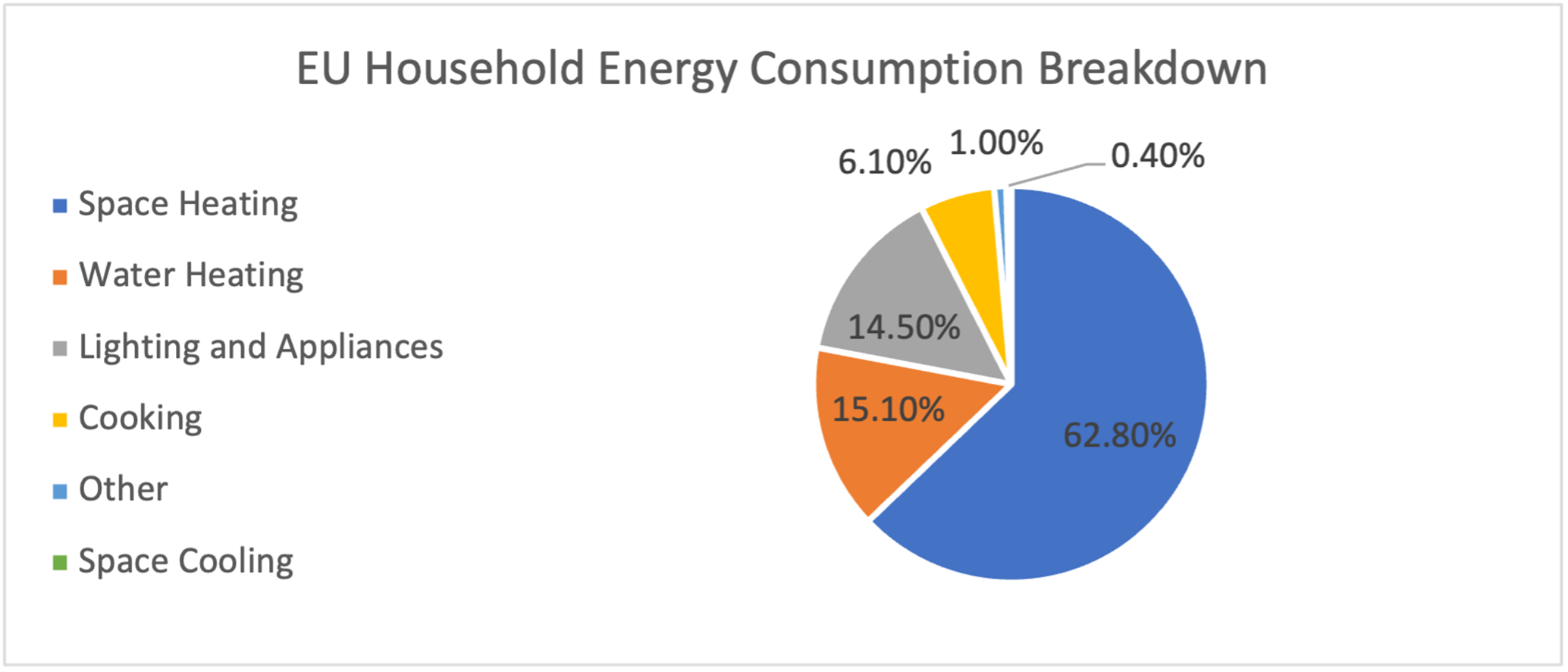
Figure 1: Household Energy Consumption Breakdown. Data extracted in June 2022. Source: Energy consumption in households - Statistics Explained (europa.eu)Hot water is the second biggest culprit of steep energy bills – use less
- Cutting your shower time from ten minutes to four minutes could save 60% of energy usage. Trying taking a four-minute shower with a shower timer.
- Prevent water from overheating by setting your hot water tank to 60°C.
- Use an eco-shower head to reduce water usage; or install a faucet aerator to reduce hot water flow from the standard 2.2 gallons/min to 1.5 gallons/min*.
Use kitchen appliances efficiently
- Only fill the kettle with the amount of water needed. The average kettle uses 0.11 kWh to heat 1 L of water.
- Use a microwave instead of the oven for heating up small amount of food. Running a microwave for an hour each day consumes half of the energy needed for a gas oven.
- Use a microwave to cook food e.g., pasta, potatoes, fish and rice, which is much quicker! Consider checking out microwave rice cookers.
- Regularly defrost the freezer to remove ice build-up, the more ice builds the less efficiently the appliance performs!
Wash cold and air dry
- Washing clothes at 30°C or on a cold water setting (for example the bright colour cycle) can save up to 60% energy per wash, as 90% of energy use comes from heating the water in a wash cycle.
- Use your washing machine, dryer and dishwasher at full loads whenever possible.
- Air dry clothes instead of using a tumble dryer whenever possible.
Don’t let standby power eat away your money
- Install a home monitor or a smart meter to monitor and control electricity usage. Energy suppliers provide free smart meter upon request*
Air Travel Emissions
Chemical Engineering Department Air Travel Emissions Report 2022-23
Authors: The Chemical Engineering Sustainability Committee
Imperial has released a Sustainable Travel Policy to prioritise climate-conscious travel as the default approach. This means minimising emissions and maximising the value of essential trips through a focus on quality over quantity.
Imperial has committed to reduce air travel emissions by 25% by 2026 against the baseline year 2017–18 (tonnes of CO2-eq per person per year). Business travel makes up a significant portion of our travel emissions, and there is great potential to reduce these emissions.
The Chemical Engineering Department’s Sustainability Committee have analysed Departmental air travel emissions to quantify and communicate our carbon footprint from our activities, in line with Imperial’s new policy. The purpose of this report aims to inform our community about our travel activities and the environmental impact that arises from the way we travel, with the expectation that gradually, travel-conscious decisions become common practice.
Travel is classified as Scope 3 emissions which include all indirect environmental impacts arising from our operations.
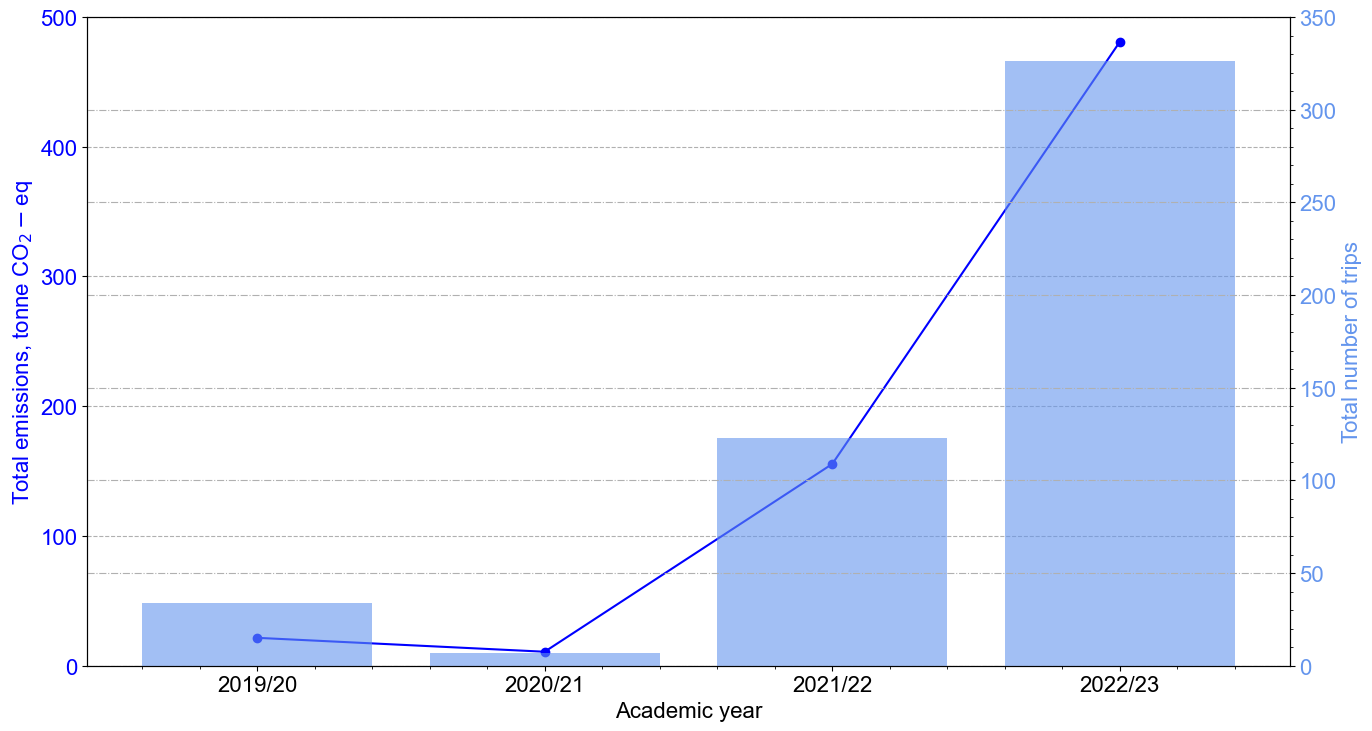
Total emissions (tonne CO2-eq): Represented by the line plot in blue, we observe a significant increase in emissions from 2019/20 to 2022/23. The rise in emissions correlates with the gradual return to pre-pandemic travel and academic/research activities which require air travel. In 2022/23, air travel emissions were close to 500 tonne CO2-eq.
Total number of trips: Shown by the bar chart in light blue, there is a noticeable increase in the number of flights over the years, particularly between 2021/22 and 2022/23. This increase is indicative of the resumption of international collaborations, conferences, and field research.
Looking at air travel habits over the last four years, the emissions per trip are as follows:
- 2019/20: 0.63 tonne CO₂-eq per trip
- 2020/21: 1.54 tonne CO₂-eq per trip
- 2021/22: 1.26 tonne CO₂-eq per trip
- 2022/23: 1.48 tonne CO₂-eq per trip
The average emissions per trip peaked in the 2020/21 academic year. This is likely due to a lower number of flights, resulting in higher average emissions per flight. Looking at the last three years, the average emissions per trip across the Department is 1.4 tonne CO₂-eq. However, this figure can vary depending on specific trips. These fluctuations highlight the impact of travel patterns and underscore the importance of optimizing travel routes and transport modes.
Emissions by cabin class
Cabin class affects the efficiency of air travel in terms of CO2-eq emissions per passenger kilometre. More airplane space for premium seating (First & Business Class) reduces the total number of passengers a plane can carry. This increases the average CO₂-eq emissions per passenger. There is no perfect way to account for this difference but the DESNZ methodology document on GHG conversion factors uses average seating configurations from airlines and aircraft manufacturers to estimate "scaling factors" for each class (see the document's Table 38). Long-haul flights have a wider variation in premium seating space compared to short-haul flights. The scaling factors adjust the average CO₂ emission based on class, lowering economy and raising business/first class emissions.
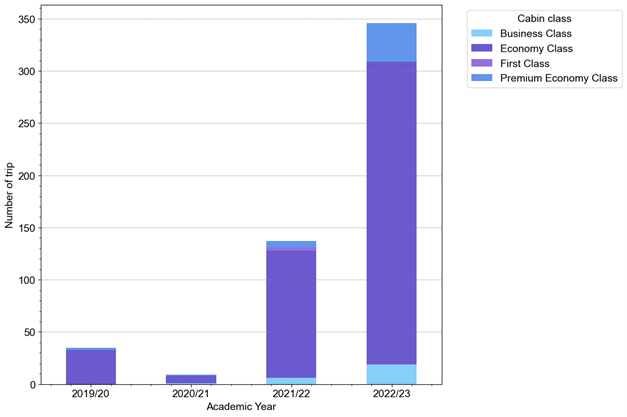
The distribution of emissions by cabin class varies by academic year, reflecting the changes in travel patterns and class preferences.
Economy Class dominates in terms of both emissions and number of flights across the academic years.
Premium Economy and Business Class have fewer flights but still contribute significantly to the total emissions due to higher emissions per flight.
First Class appears in 2021/22 with notable emissions despite having a small number of flights.
a) Total emissions
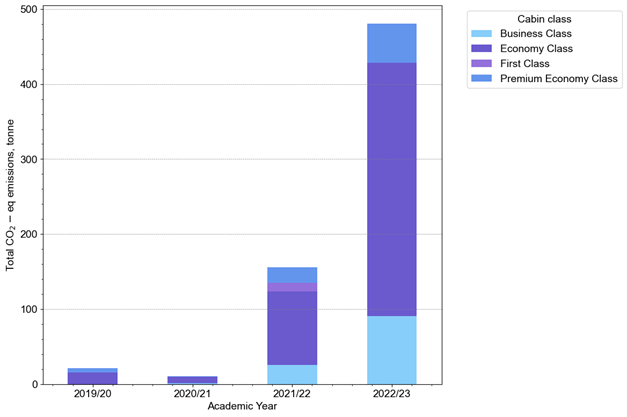
b) Per academic year, categorised by flight class
Emissions by distance
The figure below breaks down emissions from travel activities by domestic, short-haul, and long-haul flights, mirroring the DENSZ methodology. Notably, it reveals that long-haul flights contribute a significant share of these emissions.
Phoenix, US destination has the highest total CO2 emissions and the highest number of flights. This suggests frequent travel to Phoenix, due to a renowned international conference taking place in this location.
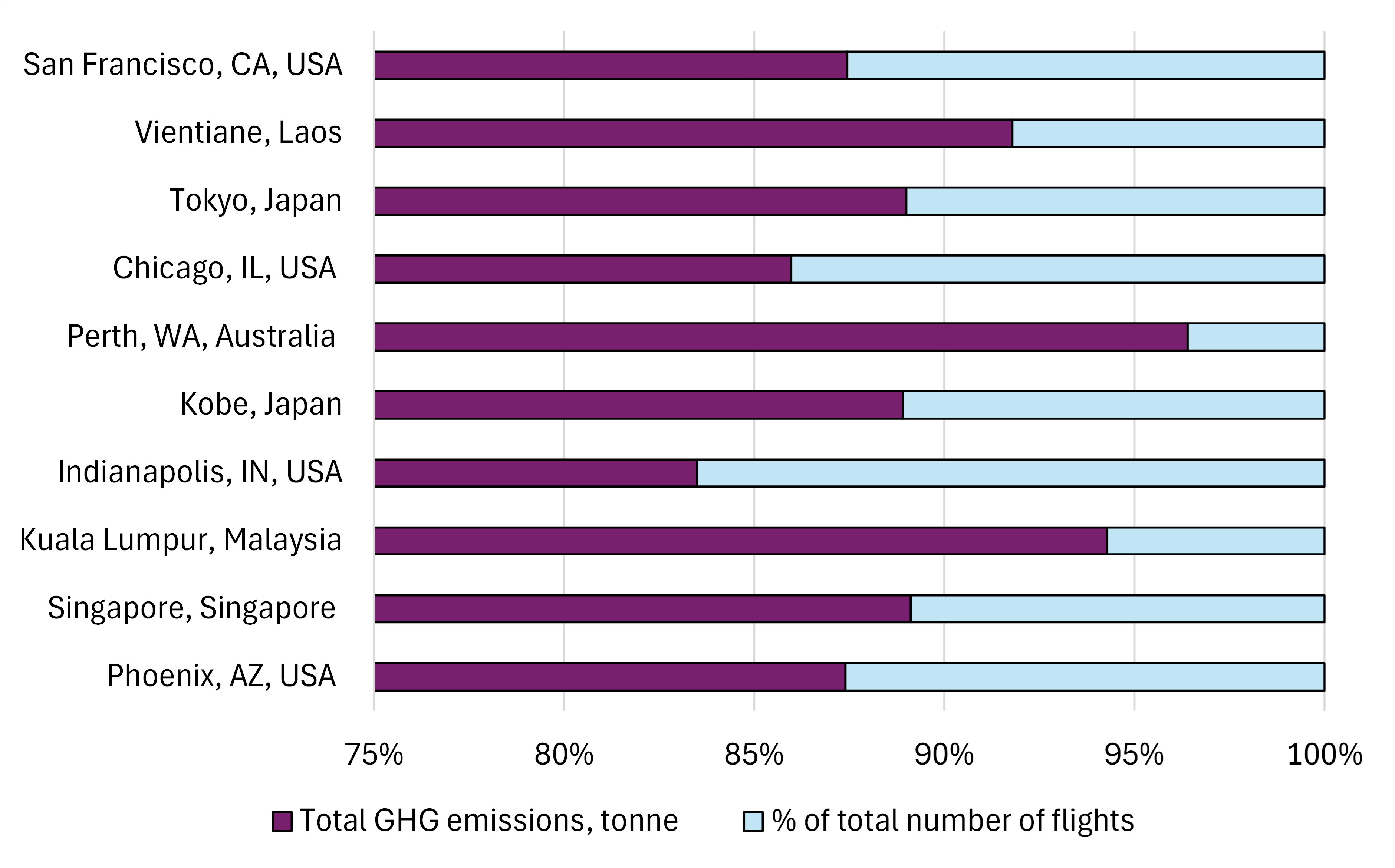
Top Travel Destination (2022/2023):
- Location: Phoenix, AZ, USA (PHX - Sky Harbor Intl. Airport)
- Number of Flights: 31
- Reason for Travel: AIChE Annual Meeting
Although the number of flights to Australia and Malaysia are fewer, their contributions to total GHG emissions are higher.
Emissions by traveller group
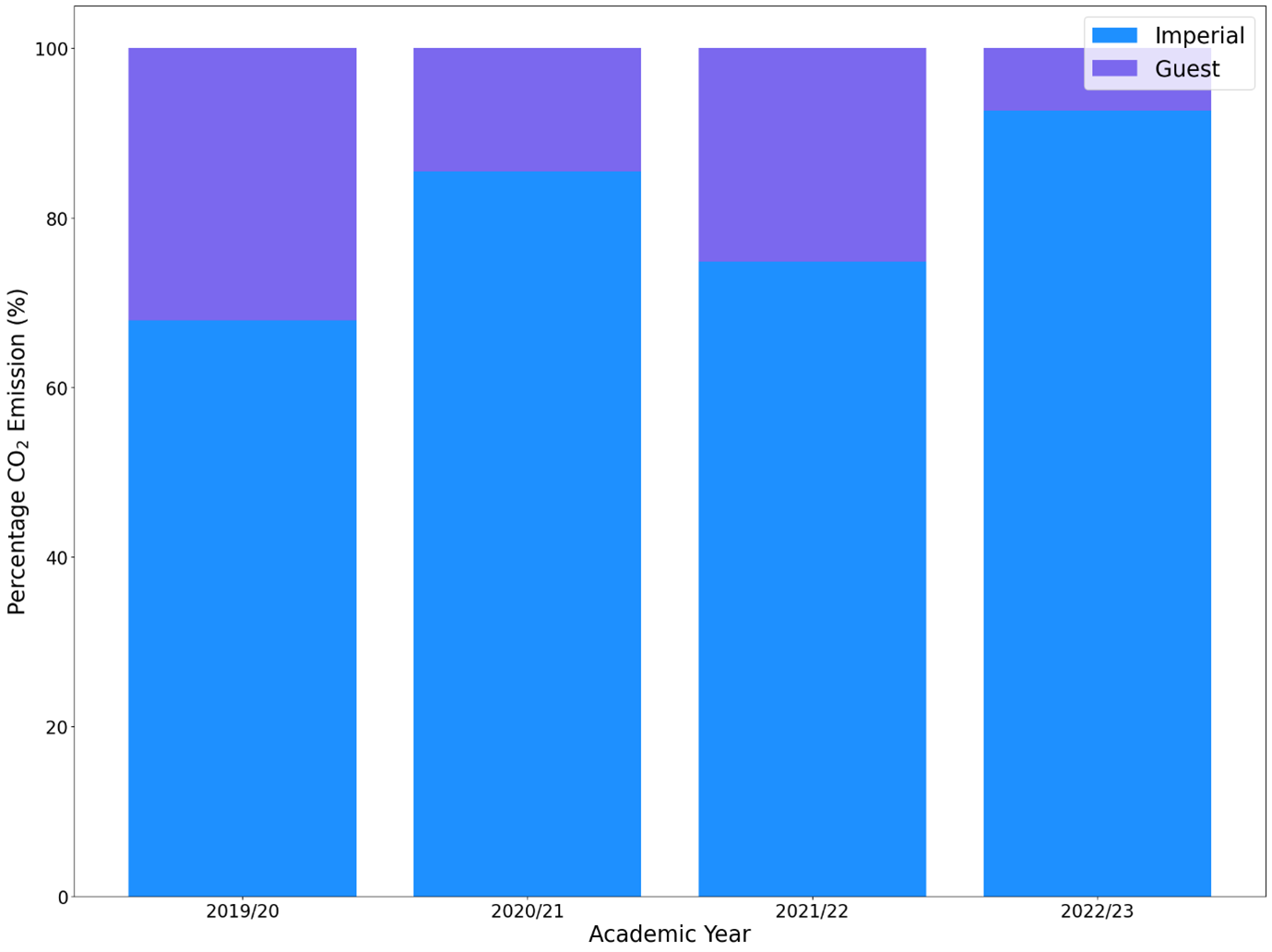
Emissions from Imperial staff and students' business travel are consistently higher than those from guest travel (visitors), although guest travel emissions can contribute up to 30% of total emissions, as seen in the 2019-2020 academic year.
Encourage the use of trains or other lower-emission transportation modes for short to medium distances (five hours or less) instead of flights.
Optimise travel routes to reduce the number of stops and layovers with longer stays and promote the use of direct flights when necessary. Consider booking your travel as early as possible to allow time to fully explore all travel options.
For long-haul flights, travel in economy class and consider premium economy before requesting business class in the case of health and welfare reasons.
About
This Committee assists the Director of Undergraduate Studies in management and decision making concerning strategic matters related to teaching and learning.
Terms of Reference (ToR)
The Committee discusses proposals made by staff for adding or amending programme and courses. Based on these discussions, the Committee makes recommendations for major and minor modifications to the Registry and Programmes Committee.
Members
- Jerry Heng (Chair of the Committee, Director of Undergraduate Studies, Professor in Particle Technology)
- Andreas Kogelbauer (Director of Course Operations)
- Vijesh Bhute (Secretary, Senior Teaching Fellow)
- Colin Hale (1st year Chair, Senior Teaching Fellow)
- James Campbell (2nd year Chair, Senior Teaching Fellow)
- Mehmet Mercangoz (3rd year Chair, ABB Associate Professor in Autonomous Industrial Systems)
- Paul Fennell (4th year Chair, Professor of Clean Energy)
- Salvador Eslava (MSc Chair, Associate Professor in Biochemical Technologies)
- Eleni Zazani (Liaison Librarian: Faculty Support (Engineering))
- Margaret Helps (Undergraduate Administrator)
- MEng Department Representatives
- MSc Department Representatives