Want a truly real-life learning experience? Imperial’s Digital Media Lab has all the answers.
Words: Clare Thorp / Photography: Joe McGorty
Everything is beeping. The patient is unresponsive and your adrenaline is surging. Colleagues are waiting for your instructions and now you’ve got just seconds to decide what to do next – and the stakes could be life or death.
For the Imperial medic faced with this unfolding emergency, it all feels incredibly real – but, in fact, it’s not. This virtual reality simulation, experienced via VR headsets, lets students confront emergency scenarios, such as a cardiac arrest or anaphylactic shock, encouraging them to make decisions against the clock while learning how to think on the spot and make the best choices for their patient.
It’s just one of many highly bespoke interactive learning experiences developed by Imperial’s pioneering Digital Media Lab (DML). Of course, a simulation of a medical emergency can never replace real-life experience – but even though students go on work placements, they may never encounter scenarios as extreme as these during their training.
VR is just one part of what DML does. “We’re trying to enrich the learning experience,” says DML’s Director, Daniel Mitelpunkt. “It’s a convergence of spatial computing, computer vision, game engines, generative AI and cloud computing. All these things together create exciting opportunities for simulation in STEM.”
But while DML has the creative and technical know-how, it is the close collaboration with Imperial departments, staff and students that gives Imperial’s education simulation its edge. “We don’t want to skew what we teach based on what technology we can randomly buy from some vendor. We want to be able to give our students something based on Imperial’s very specific curriculum,” Mitelpunkt says. “It has to be a conversation with the academic experts, and that’s a real joy.”
For the medical emergency simulation, that meant writing the scripts and choreographing the sequences alongside the medical school to make it feel as plausible as possible. The scenarios were filmed in a real hospital, with real clinicians featuring alongside actors. “The most important thing is we are teaching correct practice,” says Mitelpunkt. “It’s not just medical drama for the sake of it.”
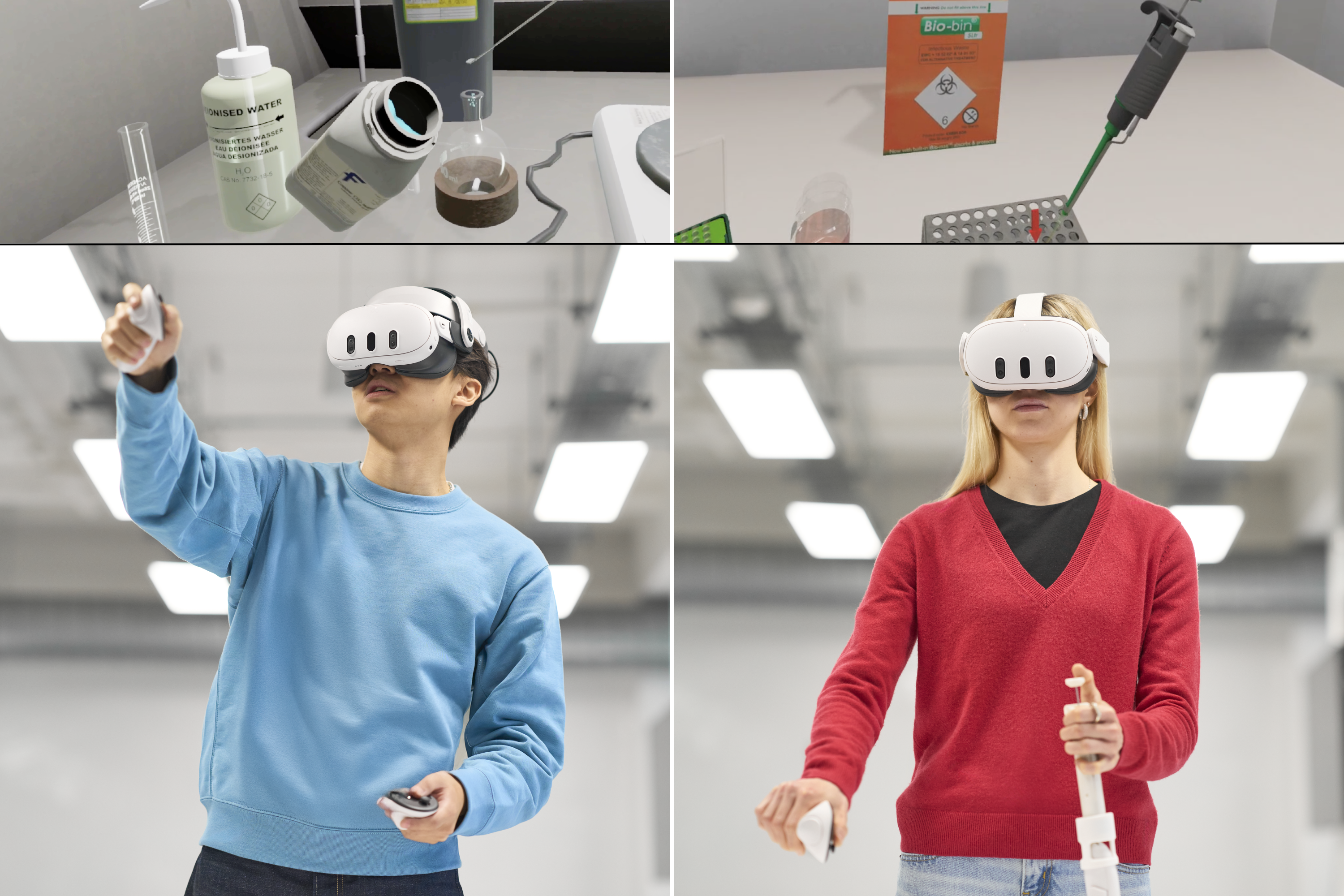
For another project, DML worked with the Department of Chemistry to create a “digital twin” of its Briscoe teaching lab. The idea is that students have the chance to familiarise themselves with the lab space and equipment in a low-stakes environment, so that they feel more confident when faced with the real thing. “They can practise and fail in a safe space. The whole ethos of these digital twin labs is not to replace, but to make better use of the time students have in the physical lab sessions.”
In a separate collaboration with the medical school, DML created a simulation for students to master using a micropipette – a precision instrument used to transfer very small volumes of liquid – working with a graduate of Imperial’s Dyson School of Design Enginering to create a pipette-like VR controller. “It’s a really nifty solution,” says Mitelpunkt.
Not all projects are about recreating real-life scenarios. A collaboration with Imperial’s Business School IDEA Lab, for instance, led to an immersive experience in which students must work together to escape an alien spaceship, with the goal of improving communication and collaboration skills. “I’m happy that we sometimes get really serious reasons for doing less than serious stuff,” says Mitelpunkt.
Through the SIM (Synchronous Interactive Media) project, DML is also working to offer interactive and immersive learning without the need for expensive hardware. “We want to bring the benefits of the latest creative tech to students and learners wherever they are, from home to a traditional teaching space.” Meanwhile another initiative, Project ViRSE, enables students to develop their own VR learning experiences alongside DML staff.
As for the future, we have only seen the tip of the iceberg of the scope for impactful, useful, high-end simulation within STEM in higher education, says Mitelpunkt. “I get really excited about what we’re going to be able to do by harnessing creative tech in conjunction with good pedagogy and subject matter expertise, and where that will take the student experience.”
DML works in collaboration with the following lead academics on the projects mentioned: Dr Risheka Walls, Dr Ravi Singh, Dr Silke Donahue, Dr Caroline Clewley and Dr Mark Sutton. For more information, visit their website.