An AI revolution: predicting disease before it strikes
Words: Peter Taylor-Whiffen
Context
 Prevention or cure? Early detection of disease is a cornerstone of modern healthcare – and technology such as electrocardiograms (ECGs) allow us to treat symptoms before they take uncontrollable, devastating hold. But imagine how much more effective treatment could be if that same tech could map our body’s future and predict the specific diseases that will strike, before we even get them. By applying AI to ECG results, one Imperial academic reckons he can achieve exactly that.
Background
ECGs have been around for a century and have already saved countless lives by detecting heart attacks and irregular heartbeats. But, says Dr Arunashis Sau, the process is rudimentary. “A clinician looks at a print-out of an ECG and decides if it’s abnormal or not – but a clinician’s interpretation depends on their individual level of knowledge and experience. Applying AI to read ECG results has many advantages – not least that it can find changes so subtle that even the most experienced human could not pick them up. My work suggests we can go one step further, using that data to predict what diseases you could get in the future.”
Method
Sau, a cardiologist and Academic Clinical Lecturer at Imperial’s National Heart and Lung Institute, is using AI and machine learning trained on gathered datasets from more than a million primary care and hospital patients on four continents. His first model – called the AI-ECG risk estimator – used an AI neural network to predict when patients were likely to die. “Neural networks have millions of connections and parameters, allowing them to link together subtle changes in different parts of the ECG in a way humans could never do,” he says. “Without AI we could not have got here.”
Results
Sau’s AI model accurately forecasts the risk of a patient’s death in the ten years following the ECG in 78 per cent of cases – and those it got wrong included unpredictable deaths, such as accidents. “We then applied the model more specifically to predict future health risks such as heart attacks, heart failure and heart rhythm problems,” he adds. “We did a lot of extremely detailed analysis, including imaging, genetics and other variables, and found AI was in part identifying something to do with the biological age of the patient. They might be 30, 40 or 50, but if they had certain adverse features causing them to age more quickly it could identify that through extremely subtle changes related to heart structure and function.”
Outcome
“This will not just predict diseases related to the heart but those outside it, such as high blood pressure, diabetes and kidney disease,” says Sau. “The goal is to be able to run this model on any ECG done anywhere in the world. A major benefit will be opportunistic detection and screening. When we identify someone with heart disease in clinical practice or hospital, often it’s at quite a late stage. Picking it up early can revolutionise someone’s life and trajectory – but this model detects the risk earlier still, before it even happens.”
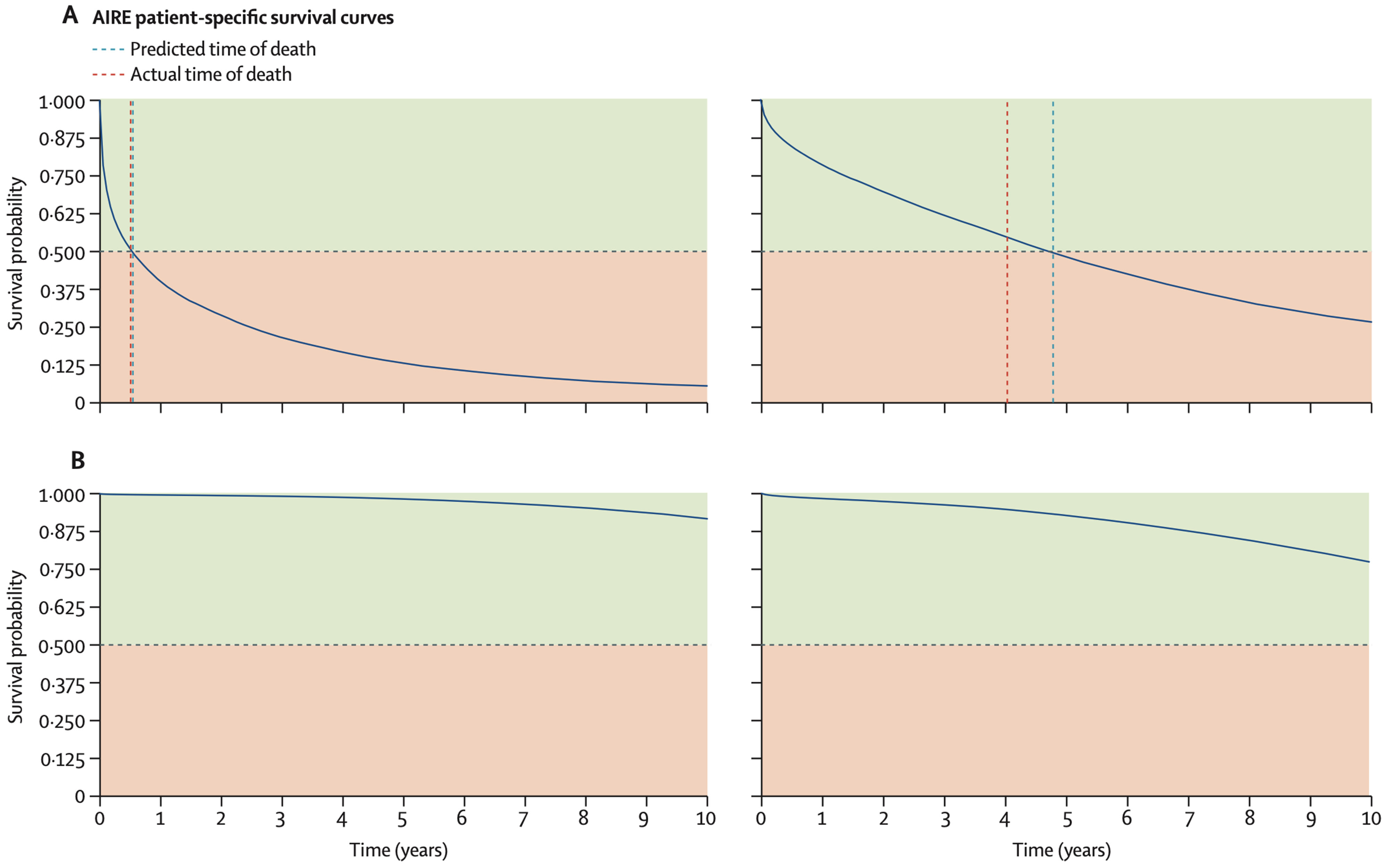
Example patient-specific survival predictions
The AI-ECG risk estimation (AIRE) platform can accurately forecast, from a single ECG, short-term and long-term mortality risk. Two examples are shown for patients who died during the follow-up period (Patients 1 and 2), and two examples are shown of patients who survived (Patients 3 and 4).
Dashed blue lines indicate the AIRE-predicted date of death.
Dashed red lines indicate the actual date of death.
Dr Arunashis Sau is Academic Clinical Lecturer at the National Heart and Lung Institute (NHLI).