Proteins, glorious proteins. The Chemical Kitchen explores the crossover between the kitchen and the lab.
Words: Frances Hedges / Photography: Imperial College London/Thomas Angus
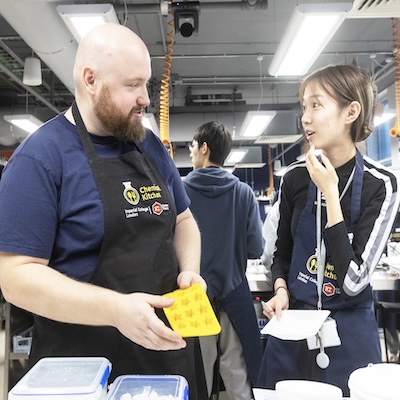 Is this a laboratory… or a kitchen? As a group of chemistry students pore over their scales and sieves – testing, observing and documenting as they go, albeit in aprons rather than lab coats – you’d be forgiven for being confused. Welcome to the Chemical Kitchen, a way of giving first-year chemists an introduction to lab work… via professional cooking.
The brainchild of a collaborative working group that included two Imperial professors (Alan Spivey and Roger Kneebone) and the chef Jozef Youssef, who specialises in molecular gastronomy, the concept was first mooted in 2019. Then came the challenge of turning its foundational principles – which centred on the idea of transdisciplinary study – into a practical curriculum. And that’s where PhD chemist Dr Luke Delmas (MRes Chemistry 2015, PhD 2019) and Dr Jakub Radzikowski, a molecular biologist and Cordon Bleu-trained chef, came in.
“I’d done some teaching already at Imperial, so I had a good understanding of what undergraduates might struggle with and where we could help ease their transition into first-year chemistry,” explains Delmas. Meanwhile, Radzikowski’s experience at fine dining restaurants had given him a clear sense of the connections between the culinary and scientific worlds. “The way of working in a professional kitchen is very similar to the techniques used in a laboratory setting,” he says.
At the core of the course are a set of cookery challenges that closely resemble real chemistry experiments – including one in which students are tasked with making ricotta cheese. “In a synthetic chemistry practical, you might take two powders, dissolve them, mix them and then get another crystalline powder precipitating from the liquid that you then dry and weigh,” says Radzikowski. “For ricotta, you take milk, dissolve citric acid in water, combine it with the milk, filter out the precipitate – which is the cheese – and finally dry and weigh it.”
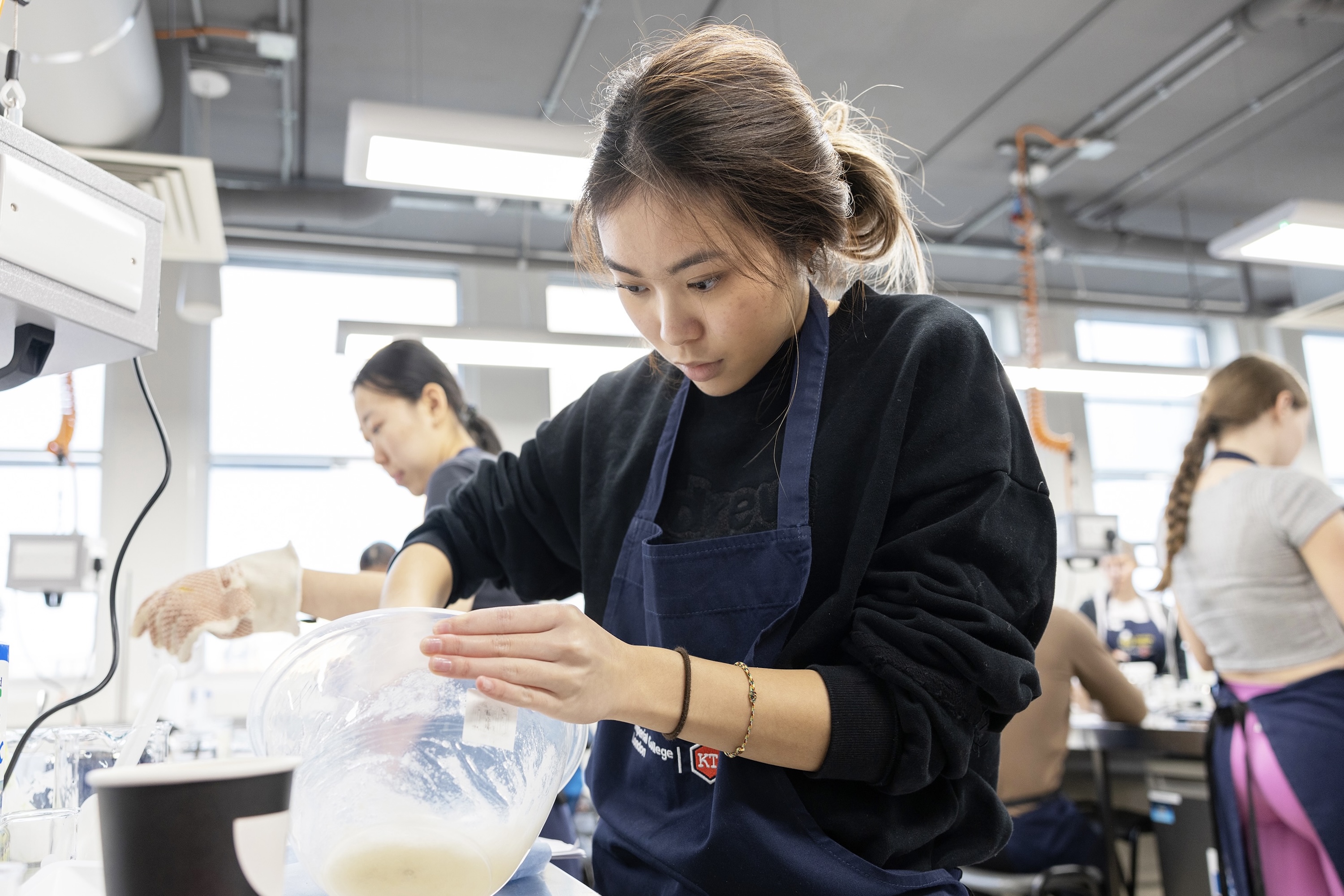
Another experiment sees participants cook an egg, extract the yolk and deep-fry it in breadcrumbs. The goal? To test out which variables, including temperature and cooking time, result in the perfect soft yolk – and then carefully record these findings. “As much as what we do is about execution, it’s also about planning and note-taking,” adds Radzikowski. “Students need to know how to logically construct a process to test out a hypothesis, and then document it properly for use in future iterations.”
Delmas agrees that the strength of the module lies in the transferable skills it offers undergraduates. “A common misconception is that the course is about looking at, say, the chemistry of carbohydrates or the structure of proteins,” he observes. “In fact, we’re teaching no chemistry! It’s all about the professional practice of making food and how teams organise themselves in that context. We’re training students in risk assessment and making a plan for how to operate safely.” Additionally, in an age when young people are less likely than ever to be proficient in manual techniques, there are benefits to be drawn from the dexterity and precision required for culinary success. “The fun comes naturally – but we do make sure it’s balanced with a carefully thought out approach to learning.”
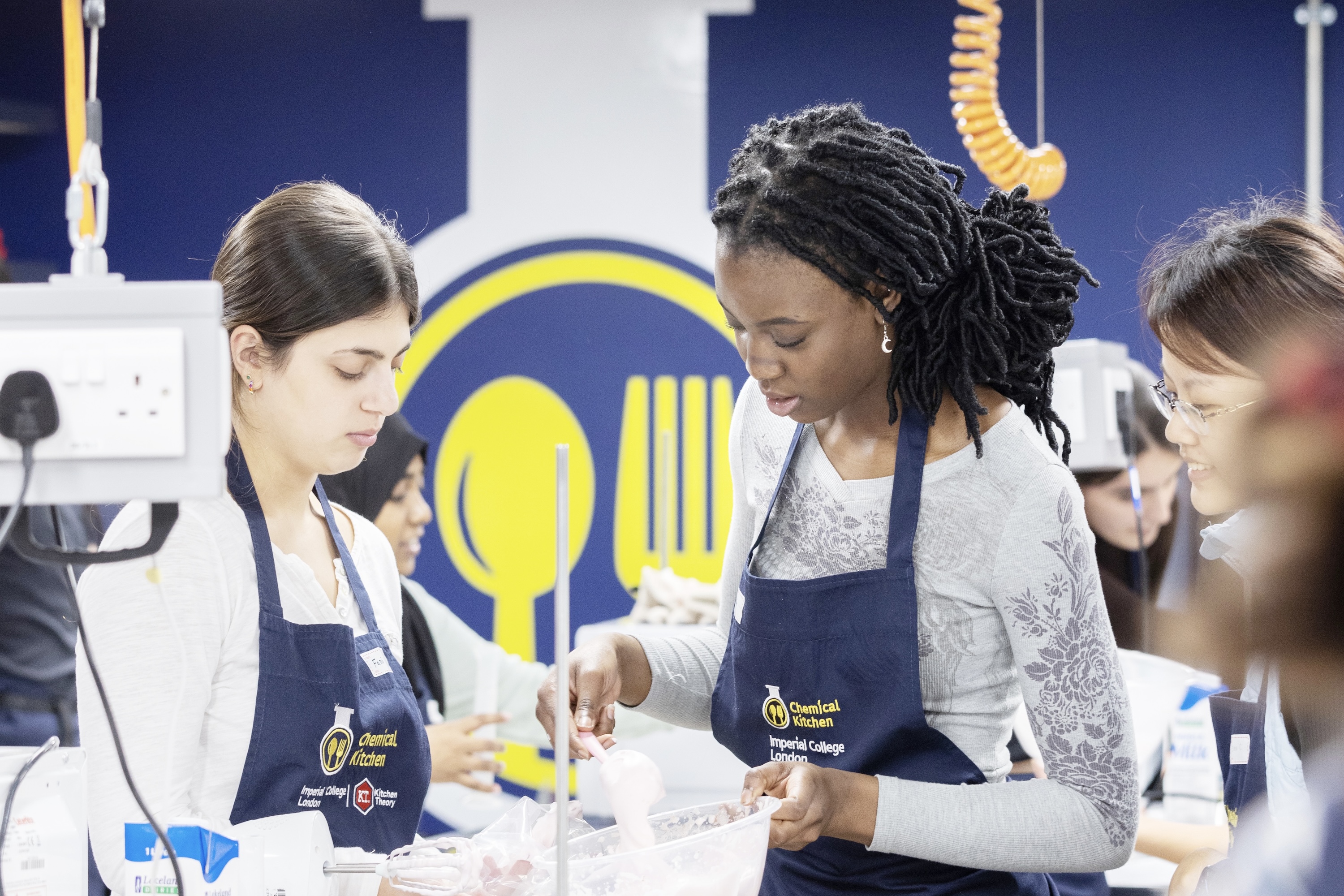
Delmas and Radzikowski report that the majority of their students approach the course with enthusiasm and emerge from it with a greater awareness of their own strengths and weaknesses. "Most of the undergraduates who come to the kitchen really enjoy what they're doing," says Radikowski. "But the true learning begins when we ask them to reflect on what they've achieved."
Their feedback has helped give rise to a number of successful offshoots from the project, including in-person and remote courses for medical students and those pursuing a qualification in executive education. “What excites me is this idea of teaching by metaphor,” says Delmas. “What can we learn about teamwork from a football coach? What can nurses learn about patient care from service at a three-Michelin star restaurant?” The possibilities are endless, agrees Radzikowski. “If there’s a learning gap that’s hard to address, we can develop an idea to solve it,” he says. “All we need is curiosity.”
Find out more about what’s on the Chemical Kitchen menu.